The direct answer
A roof leak around a cupola usually comes from one of four places: the joint where the cupola base sits on the shingles, which is often just caulk; the cut ends of the ridge cap or ridge vent on either side of it; the louvers, windows, sill, and trim on the cupola body, which let in wind-driven rain; or the cupola's own top, including seams and any weathervane or finial post. The first thing to find out is whether your cupola is vented. If there is an opening in the roof deck under it, anything that gets inside the cupola can drop straight into the attic. Stay off the roof, note which way the wind was blowing, and have the source traced before anyone seals the louvers or caulks the base again.
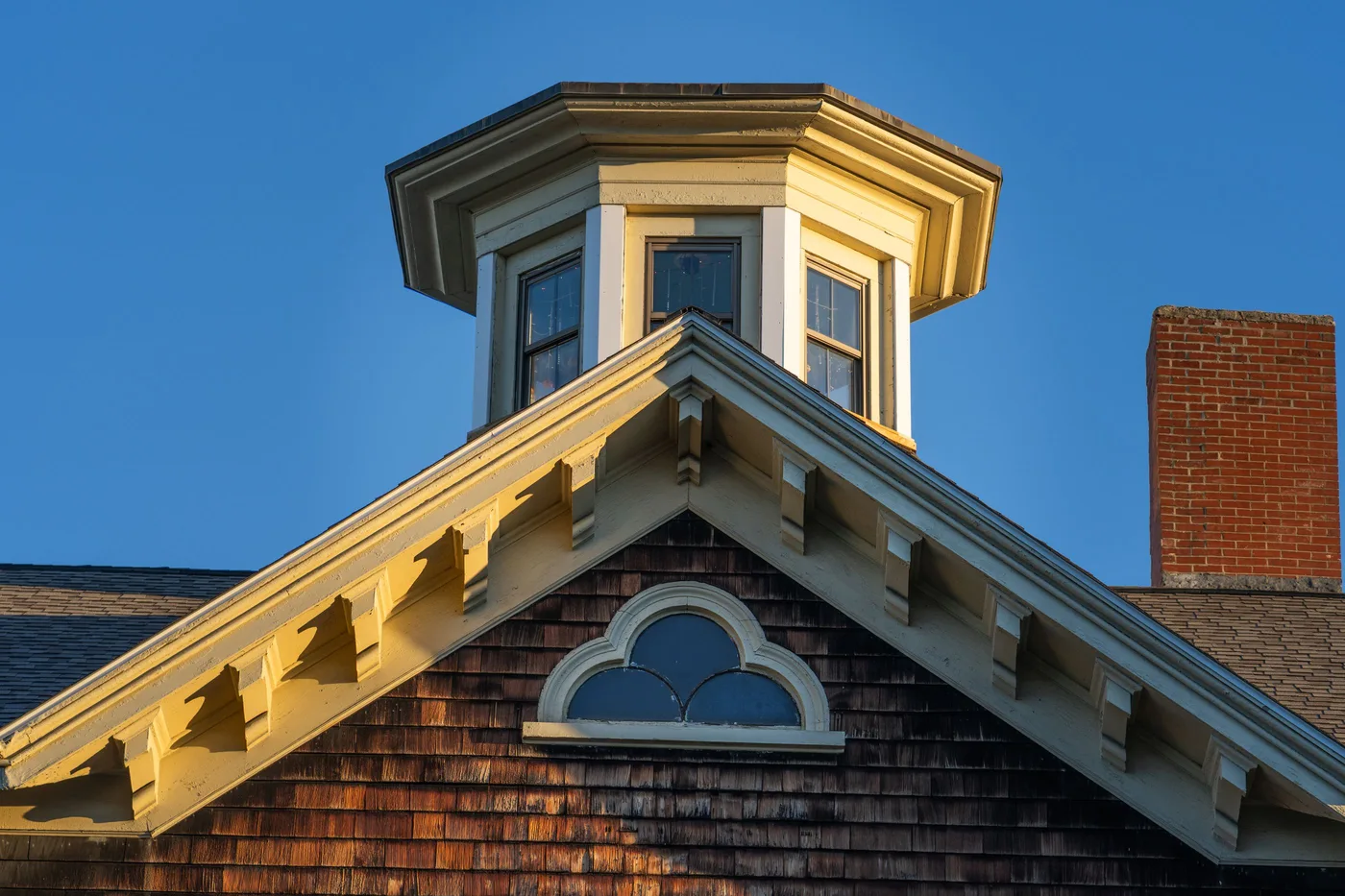
Start by finding out whether the cupola is vented
A cupola is a small boxed structure, usually on the ridge of a house, garage, or porch roof. Some are purely decorative. Others are louvered so hot, moist attic air can escape through them. Which kind you have changes how a leak behaves.
Installation instructions for one line of ready-made aluminum cupolas show the difference clearly. For a decorative cupola, the installer removes the ridge cap where the base will sit and fastens the base on top of the roof, with no hole in the deck. For a ventilating cupola, the installer also cuts an opening through the roof sheathing inside the footprint of the base, taking care not to cut the ridge board or trusses.
That opening is the reason a vented cupola can leak so directly. Rain that blows through the louvers, or drips through a top seam, has nothing under it but the attic. On a decorative cupola sitting over solid decking and shingles, water that gets inside usually has to find its way out through the base joint or under the shingles before it shows up indoors.
You can often tell from inside. If you can safely look up from a floored attic walkway near the ridge and see daylight or an open, framed hole under the cupola, it is vented. If the decking runs unbroken under that spot, it is most likely decorative. Do not crawl across ceiling joists to check; a photo from a safe spot is enough.
The four places water usually gets in
The base where it meets the shingles. This is the most common suspect. The same aluminum-cupola instructions call for silicone caulk all the way around the bottom of the base to keep water from running under it when the cupola sits on asphalt shingles, and for flashing if shingles were removed. Many cupolas, especially ones added after the roof was finished, were set this way. Caulk exposed to sun and heat shrinks, cracks, and pulls away over time, and once it opens, water running down the base walls goes under them. The North Carolina Residential Code requires flashing at wall-and-roof intersections and around roof openings, and its sidewall flashing section calls for step flashing on sloped surfaces that directs water away from the wall and onto the roof. A cupola base is a short wall on a roof, and it behaves like one.
The ridge on either side. To seat the cupola, the ridge cap is cut back where the base sits. If the roof has a ridge vent, the vent is cut too. Those cut ends sit right against the base, often finished with a little sealant. When the end shingle of the ridge cap lifts, the sealant fails, or the cut end of a ridge vent is left open, wind-driven rain can enter right at the peak. Kaliber's guide to why a ridge vent leaks covers that part of the roof in more detail.
The cupola body: louvers, windows, sill, and trim. Louvers are built to pass air, and hard, wind-driven rain can be pushed past the slats. Windowed cupolas depend on the window flashing and trim. Horizontal sills and the ledge where a narrower upper section steps out to a wider base can hold water and rot. The Journal of Light Construction published a contractor's account of tracing a long-running leak from a cupola on the attached garage of a house that was only about ten years old: the roof-to-wall flashing at the base had been reverse-lapped, flashing was missing where the upper portion of the cupola transitioned to its wider base, and the trim relied on paint and caulk to keep water out. Nothing looked wrong from outside.
The cupola top, cap, and weathervane post. The cupola's own little roof has seams, a cap, and often a finial or weathervane shaft passing through it. Seams can split, caps can loosen, and the hole around a weathervane shaft can let water run down the shaft into the cupola. On a vented cupola that water has a clear path into the attic. A steel shaft that was not well painted can also rust and stain the cupola and the roof below it.
What the location and timing of the leak can tell you
- Drips falling straight down from the opening under a vented cupola point up into the cupola itself: the louvers, the top, or the weathervane hole.
- A wet streak on the decking beside the base, or stained rafters running downhill from it, points toward the base joint or the flashing.
- Wetness right along the ridge board on one side suggests the cut end of the ridge cap or ridge vent next to the cupola.
- A leak that appears only when rain blows from one direction often involves the louvers or one side of the base. Ordinary vertical rain tends to run off; storm winds push water sideways and up.
- Rust streaks on the cupola or shingles below it suggest a corroding weathervane shaft, cap, or fasteners.
- Soft, swollen, or peeling trim or sills on the cupola mean water has been getting into the wood for a while, not just during the last storm.
These are clues, not a diagnosis. Water can run along a rafter or the top of the insulation before it shows up as a ceiling stain, so the stain is not always under the leak. Kaliber's article on rain entering the attic through a gable vent walks through the same kind of wind-direction record, and the guide to finding a roof leak when it is not raining explains how an inspector narrows a source between storms. When a water test is used on a cupola, testing from the base upward, one side at a time, keeps the results from blending together.
What to do right now
Stay off the roof. A cupola sits at the highest, most exposed point of the roof, and climbing to the ridge to look at it, especially on wet or frosty shingles, is how people get hurt. Binoculars or a zoomed phone photo from the yard will show cracked caulk, a lifted ridge cap, open louver slats, or a loose cap well enough to start.
Inside, catch the water, move belongings, and photograph every wet spot, including the attic if you can reach it from a safe walkway. If water is near a light fixture, outlet, or attic wiring, stop using that circuit and have an electrician check it. Write down the date, how hard it rained, and the wind direction.
Do not stuff the louvers with insulation or tape plastic over them from inside. That can trap moisture and hide where the water is coming from. And hold off on a fresh bead of caulk around the base until the source is confirmed; a new bead over an old failure can make the next inspection harder.
Reseal, reflash, rebuild, or remove
The repair should follow what the inspection actually finds. In general the options look like this:
- Reseal or refasten. If the base was correctly set and the sealant simply aged out, or a cap is loose, careful resealing and refastening may be reasonable, with the understanding that sealant needs periodic checking.
- Reflash the base and rebuild the ridge ends. If the base relies on caulk alone, or the flashing was lapped backward, the longer-lasting fix is usually proper flashing that sheds water onto the shingles, with the ridge cap or ridge vent ends rebuilt against it. That is roofing work, and it is the part Kaliber Roofing inspects and repairs.
- Repair the cupola body. Rotted sills, open trim joints, failed window flashing, or louvers that let in rain are carpentry or sheet-metal work on the cupola itself. Ask whether the roofer handles that piece or whether a carpenter is needed, and make sure the two scopes meet at the base.
- Remove the cupola. If it is decorative, rotting, or no longer wanted, removal is an option, but the roof has to be closed properly afterward. If it was venting the attic, that exhaust has to be replaced, for example with ridge vent. Kaliber's article on whether to close attic vents in winter explains why removing exhaust ventilation is not a free change.
One leaking cupola does not mean the roof needs replacing. If the shingles, decking, and other details are in serviceable shape, the smallest responsible repair usually stays at the cupola and the ridge beside it. A focused roof repair in Indian Trail from Kaliber carries a one-year warranty on the work Kaliber performs.
What Indian Trail homeowners should do next
- Stay off the roof and away from the ridge.
- Catch the water, protect belongings, and keep water away from electrical fixtures.
- From a safe attic walkway, photograph whether there is an opening under the cupola and where the wet wood starts.
- Photograph the cupola from the ground, including the base, the ridge on both sides, the louvers, and the top.
- Write down the date, rainfall, and wind direction each time it leaks.
- Schedule an inspection that reports, with photos, whether the water is coming in at the base, the ridge, the cupola body, or the top, and whether the cupola is part of your attic ventilation.
Kaliber offers same-day or next-day inspections in Indian Trail and nearby Union County and Charlotte-area communities, subject to current scheduling availability. For local service details, see Kaliber's Indian Trail roofing page or request a roof inspection.
Related roof-repair guidance
Common questions
Is caulk around the bottom of my cupola enough to keep water out?
It depends on how the cupola was installed, and it is a maintenance item either way. Installation instructions for one line of ready-made aluminum cupolas call for silicone caulk around the base when it sits on asphalt shingles, and add flashing when shingles are removed under it. The North Carolina Residential Code requires flashing at wall-and-roof intersections and around roof openings. A caulk-only joint that has cracked or pulled away is a common leak point, and a fresh bead over a failed joint may not last.
Should I seal the cupola louvers to stop the leak?
Not before you know whether the cupola is part of your attic ventilation. A vented cupola usually sits over an opening cut in the roof deck, so blocking it can reduce exhaust ventilation. Confirm that wind-driven rain through the louvers is actually the source, then decide whether a baffle, a different louver, or added ventilation elsewhere makes sense.
Can I just have the cupola removed?
Often, yes, but removal is roof work, not just taking off a decoration. The opening or fastener holes have to be closed with decking and underlayment where needed, the shingles and ridge rebuilt, and, if the cupola was venting the attic, that exhaust has to be replaced some other way. Ask for that full scope in writing before deciding.
Does a cupola need a cricket like a chimney?
A cupola that straddles the ridge has no uphill side, so the cricket rule usually does not come into play. The North Carolina Residential Code requires a cricket or saddle on the ridge side of any chimney or penetration more than 30 inches wide measured perpendicular to the slope, so a wide cupola set lower on a roof slope can fall under that rule.
Sources and editorial notes
- New Concept Louvers installation instructions for ready-made aluminum cupolas (via Larson Shutter), covering ridge cap removal, the ventilation opening for vented cupolas, and sealing or flashing the base
- North Carolina Residential Code Chapter 9 via UpCodes: R903.2 and R903.2.1 flashing locations, R903.2.2 crickets and saddles, and R905.2.8.3 sidewall flashing
- Kyle Diamond, "Fixing a Poorly Flashed Cupola," Journal of Light Construction
- Tim Carter, Ask the Builder, on cupola flashing and weathervane shaft support and corrosion
- Image source: "Historic Cupola on a House in Somerville" by Phil Evenden, Pexels license (cropped and resized)
Prepared from a cupola manufacturer's installation instructions, the North Carolina Residential Code, trade-press repair reporting, and Kaliber's verified service, inspection-availability, and repair-warranty information. Written with AI assistance and editorially reviewed by Grok/AI. No human approval is claimed. General homeowner guidance; not an on-site diagnosis, code ruling, ventilation design, insurance determination, or project-specific roofing recommendation.