A dead valley can leak because water reaches a short, low-drainage area where roof planes, a wall, or an eave terminate instead of flowing through a long open channel. Debris can slow the runoff, and a shallow pitch, short valley liner, misplaced fasteners, bridged shingles, failed flashing, or poorly integrated underlayment can let water cross beneath the roof covering. The correct repair depends on the actual geometry and materials: it may require opening the valley, replacing damaged decking, extending the water-control layers, and rebuilding the transition so runoff has a continuous path to the gutter. Surface caulk alone is not a reliable diagnosis or repair. A dead-valley leak can often be repaired without replacing the whole roof when the surrounding system remains serviceable.
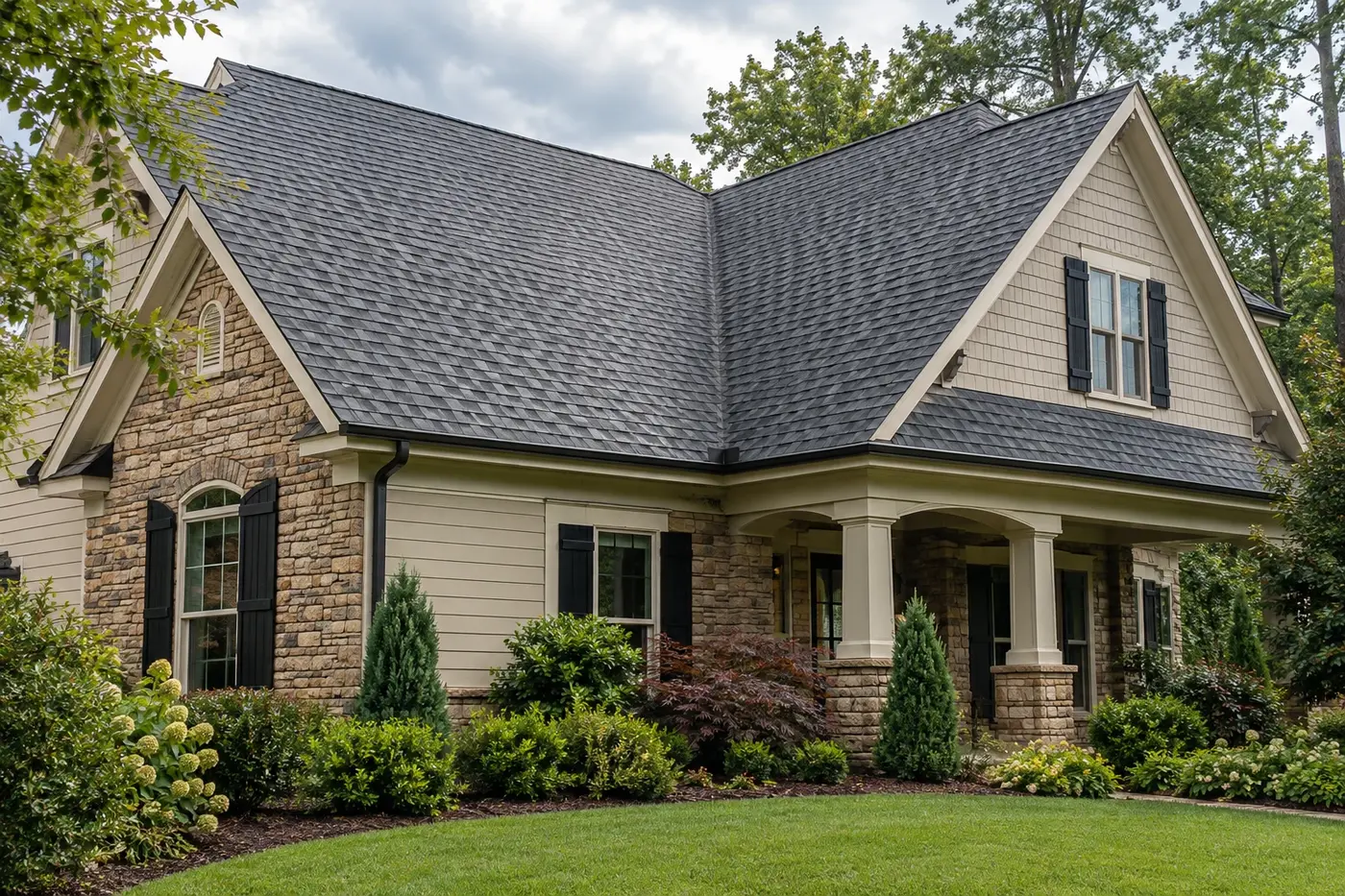
A dead valley is different from a normal roof valley
A conventional roof valley is the inside angle where two sloped roof planes meet. It normally carries rain downhill along a continuous channel. GAF describes valleys as major drainage paths and distinguishes open valleys, where metal remains visible, from closed valleys covered by shingles.
Roofers commonly use “dead valley” for a short or partly trapped intersection where that channel runs into another roof plane, wall, eave, or other obstruction. The exact shape varies from house to house. What matters is that water from more than one roof area can arrive at a small transition with less fall and less room to escape than it has in a straight valley.
That geometry makes this question narrower than a general valley leak. The repair must account for the contributing roof area, the measured slopes, the termination point, the gutter or outlet, and every layer hidden beneath the shingles. A stain below the intersection does not reveal which one failed.
Why water gets beneath a dead-valley transition
Concentrated runoff is the starting point. During hard or wind-driven rain in Indian Trail, water from two roof planes may converge faster than a short transition can release it. Leaves, shingle granules, pine needles, or a gutter backup can slow the flow further. Water can then move sideways or uphill far enough to find an open seam, nail, cut edge, or weak flashing lap.
Installation details matter because valleys are not protected by shingles alone. The North Carolina residential-code provision for asphalt-shingle valleys requires valley lining to be installed before shingles and in accordance with the manufacturer’s instructions. Owens Corning’s Duration instructions, for example, specify a 36-inch valley liner for a closed-cut valley, keep fasteners away from the centerline, and define how shingles cross and are cut at the valley.
A dead-valley condition may need a transition detail beyond an ordinary straight-valley layout. Possible failure points include a liner that stops short of the termination, underlayment lapped against the drainage direction, shingles that bridge instead of lying flat, cuts that direct water under a course, nails too close to concentrated flow, open flashing seams, or decking that has softened after repeated wetting. The correct assembly depends on the roof design, selected products, measured slope, and current code—not a universal patch detail.
Use the leak pattern to guide the inspection
From inside, record when moisture appears and identify the highest fresh water mark that can be seen safely. A drip that starts only during intense rain may fit a capacity, backup, or wind-driven entry problem. Moisture that continues after the rain can be water traveling through wet decking, underlayment, framing, or insulation. Neither pattern proves the exterior entry point by itself.
From the ground, use phone zoom to photograph the complete roof intersection, not just the lowest visible shingle. Look for debris collecting at the termination, a short gutter or outlet that overflows, raised shingle edges, an uneven cut line, exposed fasteners, old surface cement, displaced metal, or a sagging area. Do not walk into a wet valley or lean a ladder against the gutter to investigate it.
The roof inspection should then compare the interior moisture path with the entire valley, its upper entry, lower termination, nearby wall or eave, gutter discharge, and adjacent roof planes. Water can travel before it becomes visible indoors, so a repair aimed only at the spot directly above the ceiling stain may miss the real opening.
What a responsible dead-valley repair should document
Ask for overview photos that show the full geometry and close photos of the suspected failure. The written scope should identify the area being opened, the existing valley or transition type, the planned liner or membrane, flashing, shingle integration, fastening limits, decking terms, drainage outlet, and how concealed damage will be handled.
Once the covering is opened, the roofer can confirm whether the deck is sound and whether the hidden layers direct water toward the outlet. Wet, soft, delaminated, or fastener-damaged decking may need localized replacement before new layers are installed. The repair should tie into sound roofing beyond the failed boundary rather than leave new material ending inside the same vulnerable pocket.
The final detail must provide a continuous water-shedding route. Depending on the measured geometry and compatible roofing system, that may involve rebuilding a closed valley, using an approved metal or membrane transition, correcting flashing at a wall, or improving the discharge into the gutter. Manufacturer instructions and applicable code should control product-specific dimensions and installation—not a generic online diagram.
When a focused repair may be enough
A dead-valley leak does not automatically mean the entire roof needs replacement. A focused repair may be reasonable when the failure is confined to the intersection, surrounding shingles can be integrated without widespread breakage, the deck outside the wet area remains sound, and the rebuilt drainage path can connect to serviceable roofing.
A broader scope becomes more likely when the valley is only one of several active leak areas, shingles across adjoining slopes are brittle or failing, soft decking extends beyond the transition, earlier patches have buried multiple layers, or the roof geometry cannot be corrected within a narrow repair boundary. Those conclusions require on-site measurements and opened-condition evidence; they should not be made from a single interior photo.
Avoid a proposal that promises to solve the problem by coating the visible valley with roof cement. Compatible sealant can have a limited role where a manufacturer calls for it, but it cannot restore rotten decking, a short liner, reversed laps, misplaced fasteners, failed flashing, or an inadequate drainage path.
What Indian Trail homeowners should do next
Protect the interior, move belongings out of the wet area when it is safe, and keep people away from softened ceilings or wet electrical fixtures. Photograph the moisture and note the rain intensity, wind direction, and delay between rainfall and the first drip. Do not climb onto the wet roof or push debris down the valley from a ladder.
Then request a repair-first inspection that follows the water from the contributing roof planes through the dead-valley termination and into the gutter or outlet. Kaliber Roofing serves Indian Trail first and offers same-day or next-day inspections subject to scheduling, with photos and a written explanation before repair or replacement work is approved.
Related guidance
Common questions
Can a dead valley be repaired without replacing the whole roof?
Often, yes. A focused repair may be appropriate when the problem is isolated, surrounding shingles and decking remain serviceable, and the transition can be rebuilt to connect with sound roofing. Widespread brittle shingles, extended deck damage, or several leak areas can justify a broader scope.
Will cleaning debris out of the valley stop the leak?
Debris removal may restore flow when blockage is the only problem, but it does not repair damaged shingles, failed flashing, open fasteners, short valley lining, soft decking, or incorrect laps. The area should still be inspected when water has already entered the house.
Can roof cement permanently fix a dead-valley leak?
Not by itself. Roof cement cannot rebuild the hidden drainage layers or correct damaged decking and poorly integrated flashing. Sealant should be used only where the selected roofing or flashing system calls for it as part of a complete repair.
Why does the dead valley leak only during heavy rain?
Heavy rain can increase the volume and sideways movement of water at a short, low-drainage transition. Debris, gutter backup, wind, open seams, and weak hidden layers may not admit water during a light shower but can fail when runoff is concentrated.
Sources and editorial notes
- GAF explanation of roof-valley drainage, types, and common problems
- Owens Corning Duration shingle instructions for valley lining, fasteners, and closed-cut construction
- North Carolina residential-code provisions for asphalt-shingle valley linings
Prepared with AI assistance and editorially reviewed by Sage. General homeowner guidance; not an on-site diagnosis, project-specific design, code determination, or substitute for evaluation by a qualified roofing professional.