The direct answer
A roof that leaks after snow or ice in Indian Trail is usually telling you one of four things: slow snowmelt found a weak spot that ordinary rain runs past, ice at the eaves or in a valley backed meltwater up under the shingles, wind blew fine snow through a roof vent, or moisture that formed inside a cold attic is melting and dripping. The first three are roof problems; the fourth is an attic air and moisture problem that can look like one. Note when and where the water appears, stay off the icy roof, and have the source traced once the roof is clear so the repair matches the actual water path.
Why snow finds weak spots that rain misses
Rain usually arrives, runs off, and stops. Snow behaves differently. It sits on the roof and releases water slowly, sometimes for days, and it keeps that water pressed against flashing, pipe boots, vent bases, and shingle laps the whole time. A small gap that only lets in a few drops during a passing shower can let in a steady trickle when melt runs across it all afternoon.
The temperature swing matters too. The National Weather Service's 1991–2020 normals for Charlotte put the average January high near 52°F and the average low near 32°F. In practice that means winter days that thaw and nights that refreeze. Snow is not frequent around Indian Trail and Union County, but when it does fall, that daily cycle melts it in the sun, refreezes it in the shade and at the roof edge overnight, and repeats.
Shaded and north-facing slopes hold snow longest. Lower roofs under a taller roof, porch roofs, and valleys collect snow that slides or drifts off higher surfaces. Those are the places to watch after a winter storm.
The four ways winter water usually gets in
Melt finds an existing weakness. The most common winter leak is not a new problem at all. A cracked pipe boot, loose step flashing, lifted shingles, exposed nail heads, or a tired ridge cap may have been seeping quietly for a while, and prolonged melt finally carries enough water through to show up indoors. When the leak appears near a chimney, plumbing vent, skylight, or wall, that existing detail is the first suspect.
Ice backs water up at the edge. University of Minnesota Extension explains the mechanism: when snow covers a roof whose upper surface is above freezing while the lower edge stays below freezing, meltwater runs down, refreezes at the cold edge, and builds a ridge of ice. Water then pools behind that ridge and works up under shingles that were designed to shed water downhill, not hold it back. The Building America Solution Center notes that ice can also form in valleys and around chimneys, not only at the gutter line. The usual heat source is the house itself: warm air leaking into the attic through ceiling openings, thin insulation, and ductwork.
Many local roofs have less protection against that backup than roofs in colder places. The North Carolina Residential Code requires an ice barrier at the eaves where the average daily January temperature is 25°F or less, or where local design criteria call for one. Charlotte's January normal averages about 42°F, so the code does not trigger it here by temperature, and some Indian Trail roofs were built with ordinary underlayment at the edges. Kaliber's guide to ice and water shield on a roof replacement covers where that membrane is commonly added anyway.
Snow blows in through the vents. A GAF technical bulletin lists the Carolinas among the "borderline" areas where infrequent snowfall can still be blown through unfiltered ridge, hip, and roof vents. It names wind-driven snow, vents installed outside the manufacturer's instructions, unbalanced attic ventilation, and powered attic fans paired with ridge vents as leading causes. The snow lands on the insulation, melts when the attic warms, and drips through the ceiling, often a day or two after the storm. Kaliber's article on ridge vent leaks covers the rain side of the same detail.
The attic makes its own water. Warm, moist indoor air that leaks into a cold attic can condense or freeze on the underside of the roof decking and on nail tips. When the weather warms, that frost melts and drips, and it can look exactly like a roof leak. Kaliber's guides to wet attic insulation and whether to close attic vents in winter explain why covering vents is not the fix.
What the timing and location can tell you
- Water near an exterior wall or ceiling edge during a thaw, with ice along the gutters or roof edge above, points toward ice backing water up at the eaves.
- Water around a chimney, plumbing vent, skylight, or wall while snow melts above it points toward flashing or a penetration that was already weak.
- Drips or wet insulation near the ridge after a windy snowfall, sometimes with a small drift of snow on the insulation, point toward snow infiltration through a vent.
- Moisture spread across large areas of decking or many nail tips on a cold sunny morning, without snow on that slope, points toward condensation or melting attic frost.
These are clues, not a diagnosis. Water can run along rafters and the top of insulation before it shows up on a ceiling, and a roof can have more than one problem at a time. Write down the date, the weather, the wind direction during the storm, and how many days after the snowfall the water appeared. That record often narrows the cause faster than anything visible from the ground.
What to do while the roof is still icy
Stay off the roof and off ladders. A frozen roof is unsafe to walk, and the National Roofing Contractors Association generally does not recommend that homeowners try to remove ice dams or shovel snow from roofs, because breaking ice or dragging a rake across the surface can damage shingles, flashing, and gutters. University of Massachusetts building-technology guidance makes the same point about chipping ice: more harm is done to people and roofs than is prevented. Keep people and pets out from under heavy icicles and snow-loaded eaves.
Inside, put down containers and towels, move belongings, and photograph the wet area. If water is near a light fixture, outlet, or ceiling fan, stop using that circuit and have an electrician check it; Kaliber's article on roof leaks and electrical wiring explains why. If you can safely look into the attic from the hatch, a photo of where the water or snow is sitting is useful, but do not walk on ceiling joists in the dark or near wet wiring.
Hold off on sealing anything from the outside until the roof is clear. Sealant does not bond well to cold, wet surfaces, and a patch over the wrong spot can hide the real path. If the leak is active and the roof is safe to access, a roofer can sometimes set a temporary measure until conditions allow the permanent repair.
What a photo-documented inspection should trace
Once the snow and ice are gone, the inspection should start at the place where water appeared inside and work outward. In the attic, that means checking the decking, rafters, insulation, and nail tips around the wet area, the condition of the vents from below, and any sign of drifted snow or water staining under the ridge. It should also note obvious warm-air paths into the attic, such as an unsealed hatch, recessed lights, or loose ductwork, because those drive both ice at the eaves and attic frost.
On the roof, the inspection should look at the eaves and the first few courses of shingles for lifted tabs, granule wear, or water marks; the valleys and the upslope side of chimneys; flashing at walls and penetrations; and the type of ridge, hip, or roof vents installed. Gutters matter too. A gutter packed with leaves or pulled away from the fascia holds ice and water against the roof edge. Kaliber's guide to cleaning gutters before winter covers that piece.
The report should separate what was seen from what is concluded. "Water staining on the decking above the north eave" is an observation. "Ice backup caused by attic heat loss" is a conclusion that needs supporting evidence from the attic, the roof edge, and the timing.
What a lasting repair involves
The repair follows the cause. A failed pipe boot, flashing joint, or set of damaged shingles gets a focused roof repair of that detail, with any wet decking or insulation documented and replaced rather than covered over. When the leak was at the eaves, a repair that opens the roof edge is a reasonable time to discuss adding a self-adhered membrane under the first courses, even though the local code does not require it.
When snow came in through the vents, the fix may be a vent designed with an external baffle and internal filter, correct installation of the existing vent, or rebalancing intake and exhaust so the attic is not pulling air in at the ridge. A powered attic fan running alongside a ridge vent deserves a specific look.
When attic heat loss or condensation is part of the story, roofing alone will not fix it. Air sealing, insulation, and exhaust-duct corrections are often the long-term answer, and some of that work belongs to an insulation, HVAC, or building-performance professional. A good roofing proposal says so plainly instead of selling roof work to solve an attic problem.
Timing matters in winter. Kaliber's article on roof repairs in cold weather explains why some shingle work may need hand sealing or a follow-up check after a cold-weather repair. Kaliber Roofing provides photo-documented, repair-first roof repair in Indian Trail and nearby Union County communities, with same-day or next-day inspections, and repairs Kaliber performs carry a one-year warranty on that work. If you plan to talk to your insurer, Kaliber's guide to documenting roof storm damage covers what to photograph; coverage depends on your policy.
What Indian Trail homeowners should do next
- Stay off the roof and ladders, and do not chip ice or rake snow from the roof yourself.
- Contain the water, protect belongings, and keep water away from electrical fixtures.
- Photograph the wet area inside and the roof from the ground, including any ice along the edges.
- Write down the date, the wind direction during the storm, and how long after the snowfall the water appeared.
- If it is safe, photograph the attic from the hatch without walking on the ceiling.
- Schedule an inspection once the roof is clear, and ask that it check both the roof and the attic.
For local service details, see Kaliber's Indian Trail roofing page or request a roof inspection. The goal is to fix the path the winter water actually took, so the next snowfall is a non-event.
Related roof-repair guidance
Common questions
Do ice dams really happen in Indian Trail?
They are much less common than in colder climates, but they can form here. An ice dam needs snow on the roof, a warmer upper roof surface that melts it, and a colder lower edge where the meltwater refreezes. A snowfall followed by freezing nights, combined with heat escaping into the attic, can create that condition for a few days. Ice can also collect in valleys and around chimneys, not only at the gutter line.
Should I knock the ice or icicles off my roof?
No. Chipping ice, climbing onto a snowy roof, or dragging tools across frozen shingles can injure you and damage the shingles, flashing, and gutters. The National Roofing Contractors Association generally does not recommend that homeowners try to remove ice dams or shovel roofs. Contain the water inside, stay away from the area under heavy icicles, and let a roofing professional decide whether any removal is needed.
Why did my roof leak during a snowstorm but not in heavy rain?
Wind can push fine snow through roof vents that handle rain well. GAF lists the Carolinas among the borderline areas where infrequent snowfall can still blow through unfiltered ridge, hip, or roof vents, especially when the attic ventilation is unbalanced or a powered attic fan is pulling air in through the ridge. That snow melts in the attic later and can drip onto insulation and ceilings.
How can I tell a winter roof leak from attic condensation?
A roof leak usually leaves a concentrated wet area near a specific roof feature, eave, or vent, and it tracks with snowmelt or wind-driven snow. Condensation or melting frost tends to appear across broad areas of the roof decking or on many nail tips after cold nights, often without snow on that part of the roof. Both can exist at once, so the inspection should check the exterior and the attic before anyone picks a repair.
Can the roof be repaired right after the snow melts?
A temporary measure can often be made once the roof is safe to access, and a permanent repair should be done when the surface is clear, dry, and warm enough for the materials to be installed as the manufacturer requires. Asphalt shingles rely on warmth to seal, so cold-weather repairs may need hand sealing or a follow-up check. The plan should state which work is temporary and which is final.
Sources and editorial notes
- University of Minnesota Extension on how ice dams form, the role of attic heat loss and air leakage, and long-term control
- Building America Solution Center (U.S. Department of Energy) on ice dam formation at eaves, valleys, and chimneys
- National Roofing Contractors Association, "Eradicating ice dams begins below the roof deck," including its position on homeowner ice and snow removal
- University of Massachusetts Amherst Building and Construction Technology on preventing ice dams and the risks of chipping roof ice
- GAF technical bulletin TAB-R-181 on snow infiltration through ridge, hip, and off-ridge vents, including borderline areas such as the Carolinas
- 2024 North Carolina Residential Code Chapter 9, Section R905.1.2 on when an ice barrier is required
- National Weather Service Greenville-Spartanburg office, Charlotte January daily normals for 1991–2020
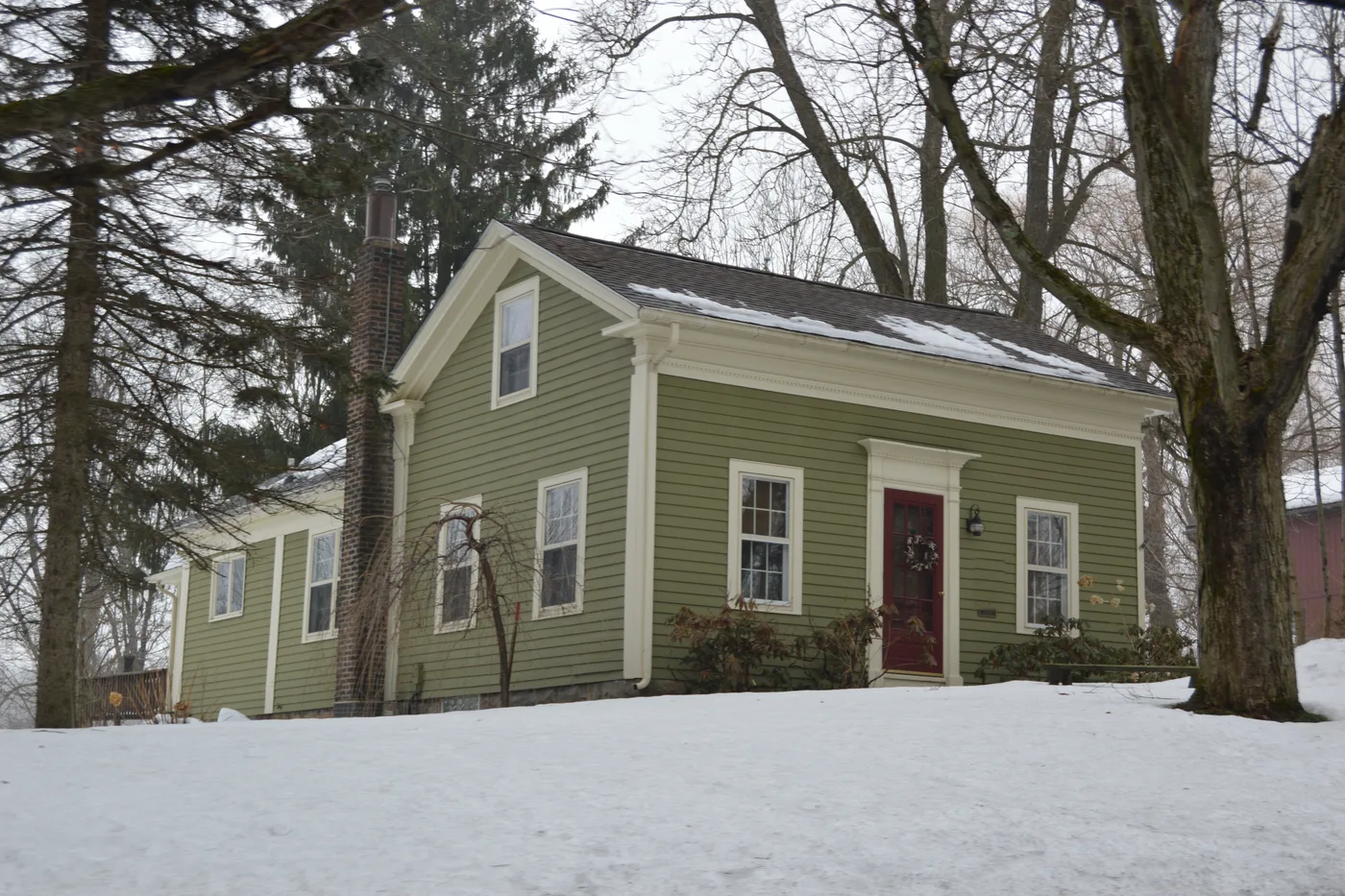
- Image source: "Fowler's Mills house" by Nyttend, released into the public domain, via Wikimedia Commons (cropped, resized, and a small sign removed)
Prepared from current accessible extension, federal, trade-association, manufacturer, code-host, and weather-service guidance plus Kaliber's verified service and repair-warranty information. Written with AI assistance and editorially reviewed by Grok/AI. No human approval is claimed. General homeowner guidance; not an on-site diagnosis, code ruling, insurance determination, or project-specific roofing, insulation, or ventilation recommendation.