Ponding water becomes a concern when it remains beyond the roof system’s expected drainage period, returns in the same low areas, reaches seams or penetrations, blocks or bypasses drains, or appears with membrane distress, soft areas, interior moisture, or changing roof shape. A puddle immediately after an Indian Trail rain does not by itself prove the roof has failed. Record when the rain stopped, map the water’s depth and boundary from safe locations, check whether drains and scuppers are obstructed, and compare the condition with the roof manufacturer’s instructions and warranty. The right response may be simple drainage maintenance, a focused membrane or flashing repair, tapered drainage work, added or relocated drainage, or evaluation of the roof deck and structure. It should not be chosen from one photo or a universal time rule.
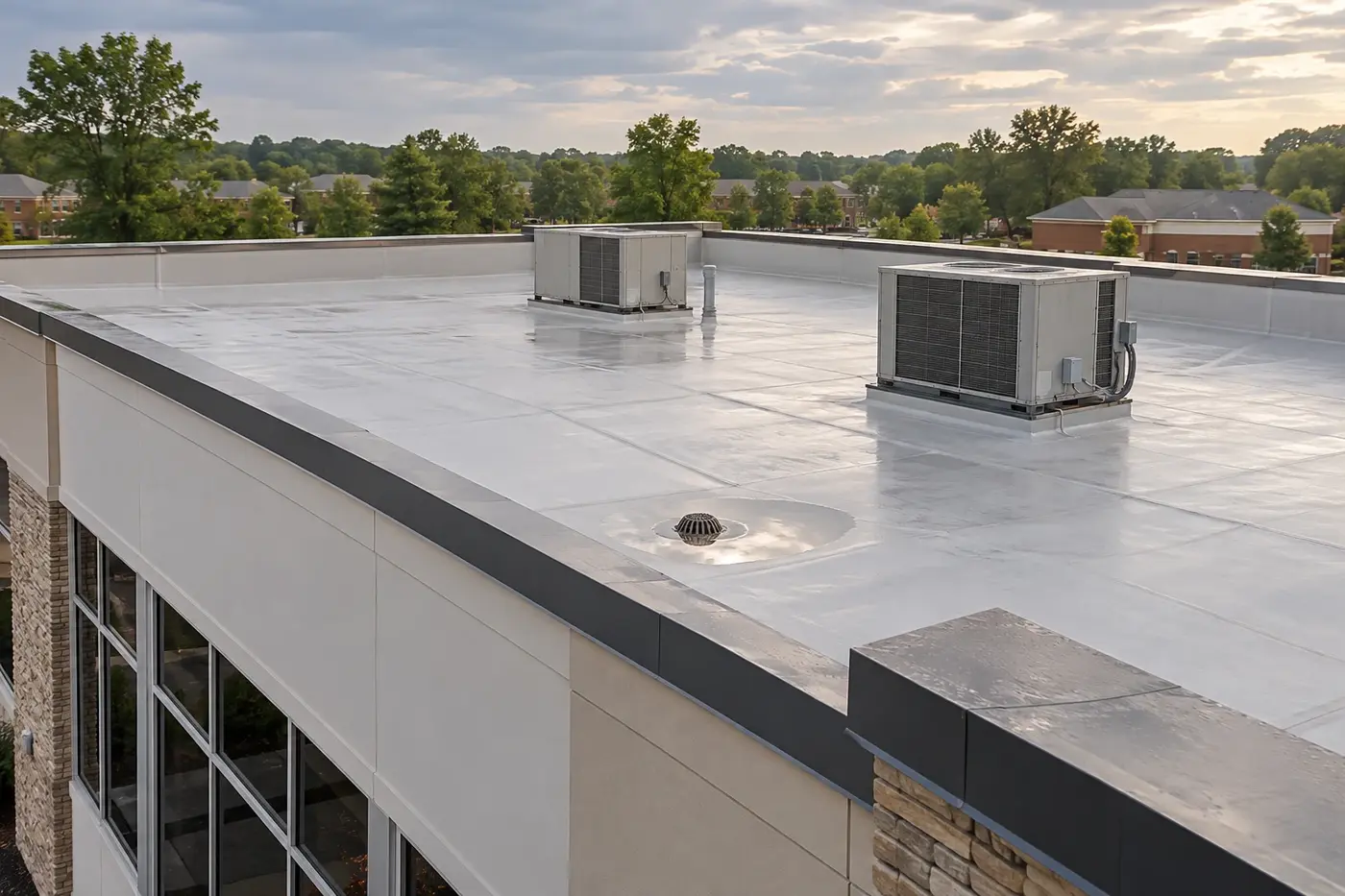
Start with time, location, and change—not one wet-roof photo
Low-slope commercial roofs are built to move water toward internal drains, scuppers, gutters, or perimeter edges, but they do not become dry the instant rain stops. Small residual areas may evaporate. The useful question is whether water drains within the period expected by the roof design, manufacturer, warranty, and actual weather conditions.
The National Roofing Contractors Association describes positive drainage as design that accounts for deck deflection and provides enough slope for drainage within 48 hours under ambient drying conditions. NRCA presents that as an industry guideline, not a promise that every roof, membrane, or warranty uses the same limit. Some manufacturers or project documents may be more restrictive, so the property’s own records control the final comparison.
Mark the time rain ended and photograph the same area at consistent intervals from an authorized safe location. Use a roof plan to identify the roof section, nearest drain or scupper, parapet, curb, seam, and rooftop unit. A repeatable record can show whether a puddle is shrinking normally, staying in one low spot, or spreading farther than it did during prior storms.
Separate a blocked drainage path from a persistent low area
Debris at a drain, strainer, scupper, gutter, or downspout can slow an otherwise functional drainage path. Leaves, roof granules, loose packaging, vegetation, and material left by another trade can move during heavy rain and collect at an outlet. GAF recommends regular inspection and cleaning because roof drains and scuppers cannot work when they are obstructed.
A clean outlet does not rule out a roof problem. Ponding can also form where insulation or the roof deck lacks sufficient slope, a drain sits above the surrounding membrane, material has settled, a curb interrupts flow, or the supporting deck has deflected. Water can also collect at poorly formed sumps and transitions even when the main roof plane appears even.
Do not let untrained staff walk through standing water to clear an outlet. Water can hide a soft deck, open seam, puncture, electrical hazard, or slippery biological growth. Building staff can document interior leaks, visible overflow, and safe ground-level discharge. Qualified personnel should control roof access and determine whether maintenance can proceed safely.
Inspect the wet area and the whole drainage route together
The roof report should show the full water boundary and close views of membrane seams, patches, fasteners, flashings, penetrations, curbs, drains, scuppers, overflow openings, and perimeter edges within or beside that boundary. Note wrinkles, open laps, punctures, blisters, surface wear, staining, algae, displaced strainers, loose flashing, or debris without assuming which item caused the condition.
Interior evidence belongs on the same roof map. Record ceiling stains, wet insulation, odors, damaged finishes, and tenant reports by date and location. Ponding water does not automatically mean the membrane is leaking, and a leak near a pond does not prove the opening sits directly above the interior stain. Moisture can travel through insulation, along decking, or around penetrations before it becomes visible below.
GAF notes that low-slope drainage design has to account for roof slope, drains, scuppers, gutters, penetrations, rooftop equipment, and expected rainfall. That is why an inspection should follow the route from the high points and crickets through low areas to primary and overflow drainage instead of treating the puddle as an isolated surface mark.
Choose the repair from the cause and the roof system
When removable debris is the only problem and the roof surface, outlet, and downstream piping remain sound, cleaning and a documented drainage check may resolve the immediate condition. The maintenance record should still show what was removed, where it accumulated, whether the water cleared, and when the outlet will be checked again.
A focused roofing repair may be appropriate when water is entering at a limited seam, flashing, penetration, drain connection, or puncture and the surrounding assembly remains serviceable. The scope should identify the exact membrane or roof system, compatible materials, repair boundary, wet-insulation process, drainage effect, warranty requirements, and before-during-after photos.
Recurring low areas can require broader work such as tapered insulation, corrected crickets or sumps, drain adjustment, added drainage, or deck and structural evaluation. Those are design and construction decisions. Water weight, deck deflection, drain capacity, overflow provisions, code requirements, and occupied-building conditions must be evaluated by the appropriate qualified roofing, design, plumbing, or structural professionals rather than guessed from an online checklist.
Use the warranty and maintenance file before authorizing work
Find the current warranty or guarantee, original roof scope, drawings, product information, drainage plan, prior inspection reports, leak history, repair invoices, and rooftop access log. Check who must be notified, who may perform repairs, what documentation is required, and whether ponding or inadequate drainage is excluded. A generic maintenance checklist does not override the written terms for the installed system.
Compare today’s condition with earlier roof maps and photos. A puddle that appears after an HVAC replacement, solar work, repeated foot traffic, drain service, or a recent storm deserves a different investigation from a stable shallow area documented for years. The comparison should identify what changed without assigning blame before the assembly is inspected.
Kaliber Roofing serves Indian Trail first and provides photo-documented commercial roof inspections with same-day or next-day availability subject to scheduling. The practical next step is a measured drainage record and a written scope that separates maintenance, membrane repair, drainage correction, and any design or structural question.
Related guidance
Common questions
Does standing water mean a commercial roof is leaking?
No. Standing water is a drainage condition, while a leak requires an opening or failed water-control detail. Ponding can increase exposure and may worsen vulnerable seams, flashings, or punctures, but the roof surface, drainage route, insulation, deck, and interior evidence still need to be evaluated together.
Is 48 hours the rule for every commercial roof?
No. NRCA uses drainage within 48 hours under ambient drying conditions in its positive-drainage guidance, but the installed roof manufacturer, warranty, project documents, roof design, and weather conditions may use different requirements. Check the actual system records before treating one time limit as universal.
Can building staff clear a commercial roof drain?
Only when the property safety program allows it and the area is dry, stable, accessible, and within the person’s training. Staff should not walk through standing water or onto a roof with suspected soft decking, electrical hazards, active storms, unsafe edges, or slippery surfaces. Qualified personnel should handle uncertain conditions.
Does ponding water mean the commercial roof must be replaced?
Not automatically. The response may range from cleaning a blocked outlet to a focused membrane repair or drainage correction. Replacement or structural work should be based on documented roof-system condition, wet materials, deck performance, drainage design, repair history, and qualified evaluation—not the presence of one puddle.
Sources and editorial notes
- NRCA guidance on ponding water and positive roof drainage
- GAF building-science guidance on low-slope roof drainage
- GAF guidance on commercial roof-drain maintenance
Prepared with AI assistance and editorially reviewed by Sage. General property-maintenance guidance; not an on-site diagnosis, warranty determination, structural conclusion, drainage design, safety plan, code decision, or substitute for the roof manufacturer, warranty provider, property safety program, or qualified roofing and building professionals.