The direct answer
For a typical Indian Trail home, the North Carolina Residential Code minimum is modest: Union County falls under the 115 mph ultimate design wind speed for counties not listed in the state table, and at that speed the code accepts asphalt shingles labeled ASTM D7158 Class D, G, or H, or ASTM D3161 Class A, D, or F. That minimum is a floor, not a recommendation. On a full replacement, the more useful questions are which exact product is being installed, which classification its current documents and wrapper actually show, and whether the nailing, starter, and ridge details match what the manufacturer requires for the wind warranty you are being promised.
What North Carolina code requires in Indian Trail
The North Carolina Residential Code uses a county table instead of the national wind map. Coastal counties carry higher ultimate design wind speeds, and any county not listed, which includes Union, uses 115 mph. Both the 2018 edition and the 2024 edition of the state residential code list that same 115 mph default.
Section R905.2.4.1 then says asphalt shingles must be tested to ASTM D7158 and labeled on the packaging with a classification that meets Table R905.2.4.1 for the design wind speed. Shingles outside the scope of D7158 can be tested and labeled to ASTM D3161 instead. In the table, the row for speeds up to 116 mph accepts D7158 Class D, G, or H, or D3161 Class A, D, or F. Class G or H becomes the D7158 minimum only above that row, and D3161 Class F becomes the only accepted D3161 class from the 142 mph row upward.
Two practical notes come with that table. First, the D7158 classes assume Exposure Category B or C, a building height of 60 feet or less, and no topographic speed-up; outside those conditions, additional calculations are required. Second, the code's six-nails-per-shingle exception applies at 130 mph or more with an eave 20 feet or higher, or at 140 mph or more. At 115 mph, the code minimum is the manufacturer's instructions and not fewer than four nails per strip shingle. Union County Building Code Enforcement has the final word on how the code applies to a specific address and permit.
ASTM D7158 and D3161 are different tests
Homeowners often see a wrapper or brochure listing “Class F” and “Class H” side by side and assume H is simply two letters better. The two letters come from different methods.
ASTM D3161 is a fan-induced test. Shingle samples on a test deck are exposed to a stream of air at 60, 90, or 110 mph for two hours; passing at those speeds earns Class A, D, or F. An NRCA technical column in Professional Roofing points out that the standard itself says its results do not directly correlate to wind speeds in service, and that it does not account for building height or exposure.
ASTM D7158 measures how strongly the sealed shingle resists being lifted and compares that with calculated wind uplift forces. Current editions tie Class D, G, and H to basic wind speeds up to 116, 155, and 194 mph. Older literature often quotes 90, 120, and 150 mph for the same classes; ASTM notes those are the equivalent allowable-stress design speeds, so both sets of numbers describe the same classes. Because D7158 depends on the sealant strip bonding, it is a reminder that a shingle's rated performance assumes it has actually sealed down.
The useful takeaway is simple: compare D7158 classes with D7158 classes and D3161 classes with D3161 classes. A product can carry both labels.
The wrapper class is not the warranty wind speed
A third number usually appears in sales material: the manufacturer's limited wind warranty, written in miles per hour. That number is a warranty term, not a code classification, and it often depends on installation details.
Two current manufacturer documents show the pattern. GAF's shingle and accessory limited warranty lists 110 mph wind coverage for its lifetime shingles without special installation and 130 mph with it. For most of those shingles, special installation means six nails per shingle plus GAF starter strip products at the eaves and rakes; its LayerLock-labeled shingles reach the higher figure with four nails plus the starter products. An Owens Corning Oakridge data sheet likewise lists 110/130 mph, with 130 mph applying only with six-nail application and Owens Corning starter shingles at the eaves and rakes.
Wording and requirements change and differ by product line, so treat those as examples rather than rules for every shingle. The point for a homeowner is that a quoted wind warranty speed is only as real as the installation steps behind it. If the estimate promises the higher number, it should also commit to the nail count, the starter product, and the hip and ridge products and methods the warranty requires.
What to check in a replacement estimate
A wind rating is easiest to verify before the first bundle is opened. These are reasonable things to ask for in writing:
- The exact product line, not just the brand. Kaliber's guide to comparing shingle brands in roof estimates explains why a manufacturer name alone does not identify a product.
- The classification on the current data sheet, naming the test: for example, “ASTM D7158 Class H” or “ASTM D3161 Class F.”
- The nailing plan. Four or six nails per shingle, and why. If six nails are needed for the promised warranty speed, the estimate should say so.
- Starter at the eaves and rakes. The edges are where uplift starts, and some enhanced wind warranties name a specific starter product. See whether a roof replacement includes new starter shingles for what that line item should cover.
- Hip and ridge products and their installation instructions, since caps can carry their own wind terms.
- Wrapper photos and paperwork at the end of the job. The code requires the wind classification on the packaging, so a photo of a wrapper from the delivered material ties the finished roof to the label.
Cold-weather installs deserve one more question. Self-sealing strips need warmth to bond, and manufacturers publish their own instructions for shingles installed when it is cool. Ask how the crew will follow those instructions if the roof goes on during an Indian Trail winter.
When it makes sense to aim above the code minimum
Because the Union County minimum accepts the lowest classes in both tests, many homeowners reasonably ask for a product labeled higher. Doing so tends to make more sense when the house sits on an open or elevated lot, has long rake edges or tall gables facing open ground, is close to the 60-foot assumption in D7158, or when the owner plans to stay long enough to care about the warranty terms that come with a higher rating.
It is also worth comparing what you are actually paying for. A higher class on the wrapper is a product choice. A higher warranty wind speed is usually an installation and accessory choice. Both matter, and both should appear in the written scope rather than in a conversation.
Wind and hail are separate questions. Impact ratings come from a different test, covered in Kaliber's guide to whether Class 4 impact-resistant shingles are worth it. A shingle can be strong in one test and ordinary in the other.
What a wind rating cannot do
No label makes a roof storm-proof. A rated shingle installed with nails placed high, a missing starter course at the rake, an unsealed ridge cap, or a weak deck can still lift. Flashing, vents, and edge metal are separate parts of the roof that have their own installation requirements.
A wind rating also does not decide an insurance claim. Coverage turns on the policy, the cause and timing of the damage, and the insurer's evaluation. If you are considering a higher-rated product partly for insurance reasons, ask your carrier in writing whether it affects anything on your policy before you choose.
What Indian Trail homeowners should do next
- Find any records for the current roof: estimates, invoices, warranty registration, and wrapper photos.
- Ask each roofer to name the exact shingle line and its ASTM D7158 or D3161 classification from the current data sheet.
- Ask which wind warranty speed is being offered and which installation steps that speed requires.
- Compare estimates line by line on nail count, starter, and hip and ridge products, not just shingle price.
- Keep a wrapper photo and the final invoice with your house records.
Kaliber Roofing provides roof replacement in Indian Trail NC and nearby Union County communities, with same-day or next-day inspections. Kaliber's roof replacements carry a 10-year workmanship warranty, which is separate from any manufacturer's material and wind warranty. For local details, see Kaliber's Indian Trail roofing page or request a roof inspection.
Related roof-planning guidance
Common questions
Does Indian Trail require high-wind shingles?
Not in the sense most people mean. Union County is not listed separately in the North Carolina Residential Code county wind-speed table, so it falls under the 115 mph ultimate design wind speed for counties not listed. At that speed, the code shingle table accepts ASTM D7158 Class D, G, or H, or ASTM D3161 Class A, D, or F. Many homeowners choose a product labeled above that minimum, but the minimum itself is not a special high-wind class. Confirm the current requirement for your address with Union County Building Code Enforcement.
Is a Class F shingle better than a Class H shingle?
They are not on the same scale. Class F comes from ASTM D3161, a fan test run at a set air speed. Class H comes from ASTM D7158, which compares the measured uplift resistance of the sealed shingle with calculated wind uplift forces. A product can carry both labels. Compare the classification each test assigns rather than treating the letters as one ladder.
Do shingles in Indian Trail need six nails each?
The North Carolina Residential Code requires at least the number of fasteners in the manufacturer’s instructions and not fewer than four per strip shingle. Its six-nail exception is tied to ultimate wind speeds of 130 mph or more with tall eaves, or 140 mph or more, which is above the 115 mph listed for counties such as Union. Some manufacturers still require six nails, plus their own starter products, before a higher wind warranty speed applies, so the estimate should state the nailing plan.
Does a 130 mph wind warranty mean my roof will survive 130 mph winds?
No. A manufacturer wind warranty is a limited warranty with its own conditions, limits, and claim process. It is not a code classification and not a promise that no shingle will lift in any storm. Read the current warranty for the exact product and note which installation steps it requires for the higher wind speed.
How can I find the wind rating of the shingles already on my roof?
Start with paperwork: the original estimate or invoice, product names, wrapper photos, warranty registration, and any leftover bundles. The code calls for wind classification labels on asphalt shingle packaging, so a saved wrapper is useful evidence. Without records, a roofer may be able to identify the product line from the shingle itself, but the exact classification can be difficult to confirm after installation.
Sources and editorial notes
- 2024 North Carolina Residential Code Chapter 3, Table R301.2(4) ultimate design wind speeds by county (counties not listed: 115 mph), via UpCodes
- 2024 North Carolina Residential Code Chapter 9, Section R905.2.4.1 and Table R905.2.4.1 shingle wind classifications, R905.2.6 attachment, via UpCodes
- 2018 North Carolina Residential Code Chapter 9 shingle wind classification table, via UpCodes
- Mark S. Graham, “The wind resistance of shingles,” Professional Roofing (NRCA), September 2018, on ASTM D3161 and D7158
- ASTM D7158/D7158M-24a preview on Class D, G, and H wind speeds, ASD equivalents, and the standard's exposure and height assumptions
- GAF Shingle & Accessory Limited Warranty, wind speed coverage and special installation requirements
- Owens Corning Oakridge shingle data sheet, wind resistance limited warranty note
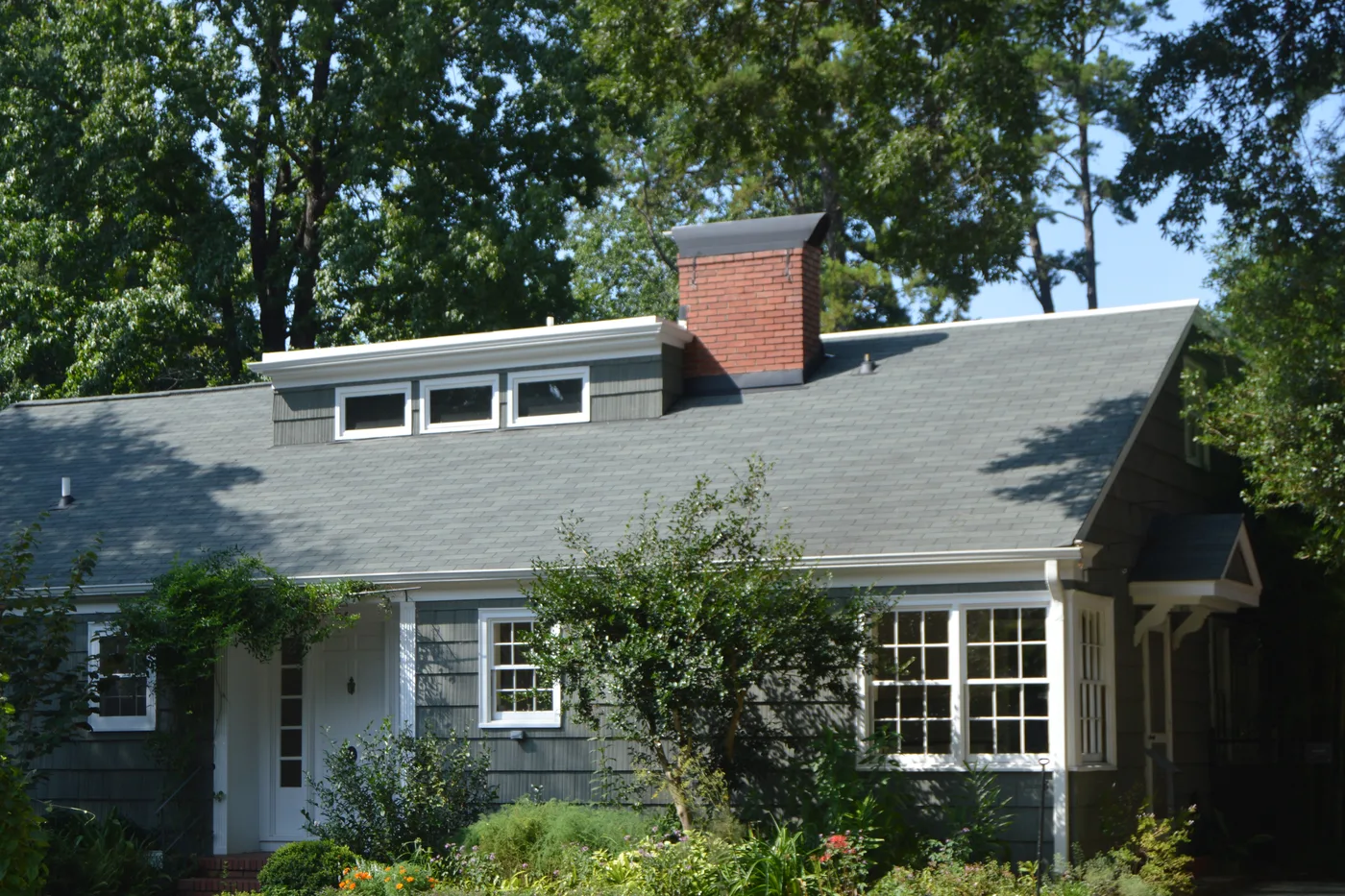
- Image source: "Elizabeth Lawrence House" by Nyttend, released into the public domain, via Wikimedia Commons (cropped, resized, house number removed)
Prepared from current North Carolina code text, standards and trade sources, manufacturer documents, and Kaliber's verified service and warranty information. Written with AI assistance and editorially reviewed by Grok/AI. No human approval is claimed. General homeowner guidance; not a code ruling, engineering calculation, warranty interpretation, insurance advice, or project-specific roofing recommendation. Confirm current requirements with Union County Building Code Enforcement and current product documents with the manufacturer.