Start by asking every contractor to show the measured roof area before waste, then explain the material order, roof complexity, accessory quantities, and allowances separately. One roofing square equals 100 square feet of roof surface, but the number of squares ordered can be higher than the measured area because shingles are cut at valleys, hips, rakes, walls, and penetrations. Two Indian Trail replacement estimates are not truly comparable when one lists measured area and the other lists only a larger material total. Put both on the same basis before comparing price.
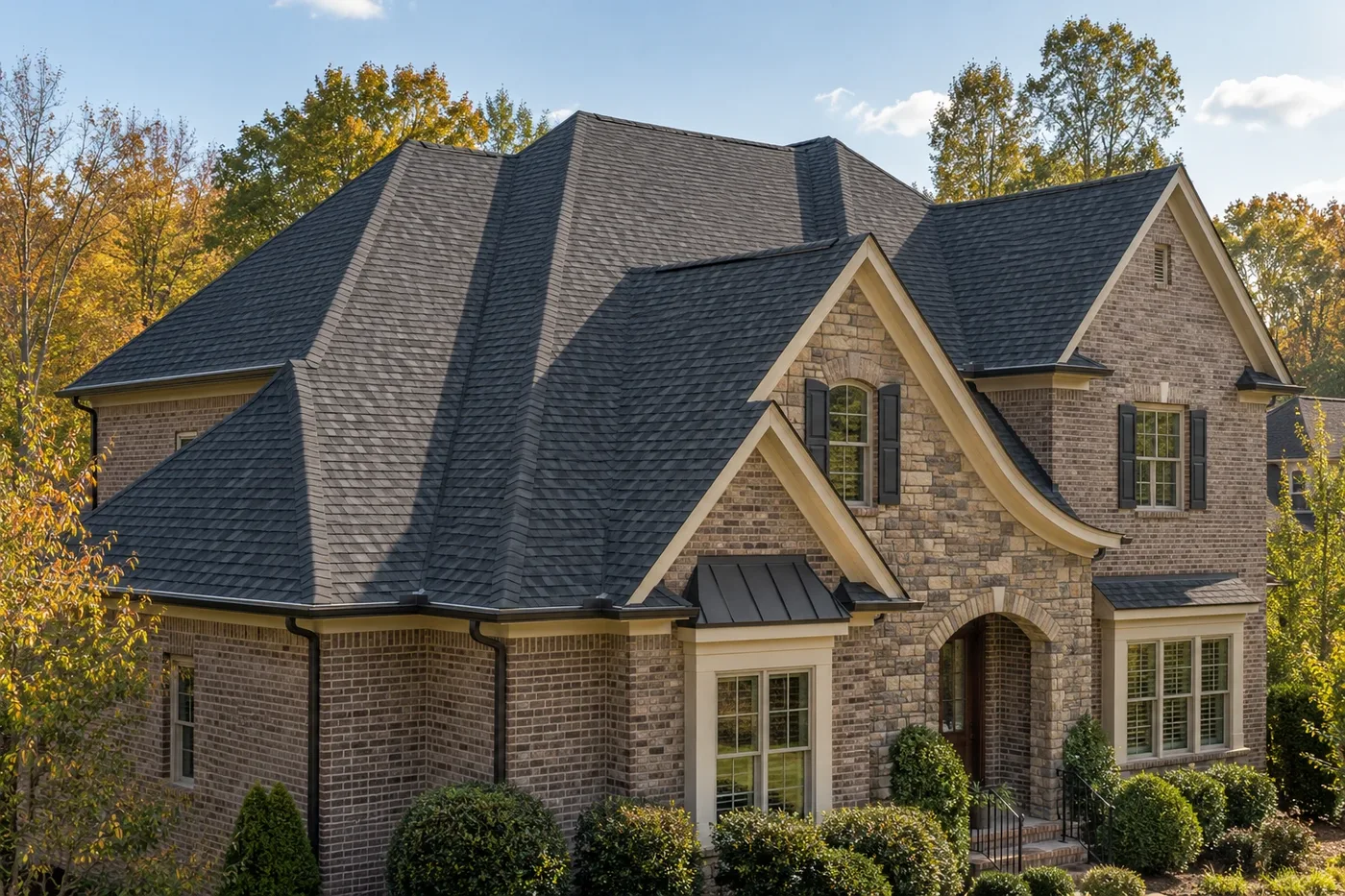
Separate the roof measurement from the material order
A roofing square is a unit of area, not a description of everything included in a roof project. GAF defines one roofing square as 100 square feet of roof area. The measured roof area should represent the surface of all roof planes, including overhangs and covered sections—not the home’s interior living area or the footprint shown on a real-estate listing.
The material order is a second number. Shingles must be cut and overlapped around hips, valleys, rakes, dormers, walls, and penetrations. Owens Corning explains that waste accounts for those cuts and overlaps and that the amount can vary with roof style and roofing material. That is why a proposal may reasonably order more shingle coverage than the roof’s measured surface area.
Ask the contractor to label both numbers. For example, the proposal can state the measured roof area in square feet and squares, then state the planned shingle quantity or waste allowance separately. Do not subtract the larger number from the smaller one and assume every difference is material thrown away; starter courses, ridge caps, bundle coverage, pattern layout, and retained spare material may be tracked separately depending on the estimating system.
Make sure both estimates measured the same roof
Aerial reports, hand measurements, plans, and direct roof measurements can all produce useful takeoffs when the roof edges, pitch, and visible obstructions are captured correctly. The method matters less to a homeowner than the completeness of the result. Each proposal should account for every main roof plane, garage, porch or entry roof included in the project, overhang, dormer, and attached section within the replacement boundary.
Compare the diagrams or measurement summaries side by side. A large difference may come from a missing roof section, a different pitch, a different eave or rake boundary, an addition included by only one contractor, or one report showing ordered material while the other shows bare roof area. Ask each contractor to reconcile the difference in writing rather than treating the larger or smaller number as automatically correct.
Indian Trail homes can have simple gables or rooflines with several hips, valleys, wall intersections, and covered entries. Two roofs with the same measured surface area can require different cutting, flashing, staging, and labor. The area is an important comparison point, but it is not a complete explanation of project complexity or price.
Do not force linear accessories into one square-foot number
Field-shingle area is only one part of a replacement. Starter shingles are measured along eaves and sometimes rakes according to the selected system. Hip and ridge caps follow the linear length of hips and ridges. Drip edge follows roof edges. Valleys, wall flashing, pipe boots, skylights, chimneys, vents, and other penetrations have their own quantities and details.
Ask each estimate to identify those components instead of hiding them inside a generic per-square description. A roof with many hips may need substantially more cap material than a two-plane gable roof of similar area. A roof with several wall intersections or penetrations also carries a different flashing scope. The replacement should follow the selected product instructions and the actual roof geometry, not a universal accessory allowance copied from another house.
Decking is different again because some conditions remain concealed until tear-off. A responsible proposal should state what deck inspection is included, how replacement is measured or priced if damaged wood is found, what documentation you will receive, and how a change is approved before the area is covered.
Use five lines to normalize competing estimates
Build a short comparison table with five rows: measured roof area; planned field-shingle quantity and explained waste; linear or counted accessories; concealed-condition allowances or unit prices; and explicit exclusions. Add the exact shingle line, underlayment, leak-barrier locations, flashing plan, ventilation work, tear-off layers, cleanup, warranties, and payment schedule after those quantities agree.
Write “not stated” when a proposal is silent. The Federal Trade Commission recommends written estimates that describe the work, materials, completion date, and price, and advises homeowners not to choose automatically by the lowest bid. A contractor should be able to explain a meaningful measurement difference and revise the written scope when clarification changes the total.
Do not compare only price per square. One contractor may divide the entire project price by measured roof area; another may quote an installed material quantity; a third may include decking, flashing, ventilation, permits, or disposal differently. Price per square becomes useful only after the roof boundary, products, quantities, and included work are aligned.
Measurements should support the decision, not make it for you
A precise roof report does not prove that replacement is necessary. Condition evidence should still show why a focused repair is or is not dependable. Today’s Indian Trail guide about repairing a roof after rain explains why the actual shingles, underlayment, flashing, decking, and moisture conditions must support the work—not just the calendar or a measurement report.
If replacement is justified, ask for the measurement summary and final written scope before signing. After installation, keep the contract, changes, final invoice, exact products, staged photos, manufacturer documents, and contractor workmanship warranty together. Kaliber Roofing provides a 10-year workmanship warranty on roof replacements; that is separate from the manufacturer’s material warranty.
Kaliber Roofing serves Indian Trail first with photo-documented, repair-first inspections and same-day or next-day availability subject to scheduling. The goal is not to produce the biggest measurement. It is to define the correct project boundary, explain every meaningful quantity, and give the homeowner a scope that can be compared before work and verified after it.
Related guidance
Common questions
What does one roofing square mean?
One roofing square equals 100 square feet of roof surface area. It is not the same as 100 square feet of living space, and it does not by itself identify waste, ridge caps, starter, flashing, ventilation, decking, labor, or other scope items.
Why is the shingle order larger than the measured roof area?
Shingles are cut and overlapped at valleys, hips, rakes, walls, penetrations, and other details. Roof complexity, product packaging, layout, and the plan for spare material can also affect the order. Ask the contractor to show measured area and the added material allowance separately.
Should two roofers get exactly the same roof measurement?
Small differences can occur because of methods, rounding, or how reports label ordered material. A large difference should be reconciled by comparing roof boundaries, planes, pitch, overhangs, additions, diagrams, and whether each number represents measured area or material quantity.
Is the lowest price per roofing square the best estimate?
Not necessarily. Price per square is meaningful only when the estimates cover the same roof area, products, tear-off, accessories, flashing, ventilation, decking terms, cleanup, documentation, and warranty scope.
Can an aerial roof measurement prove I need replacement?
No. Aerial measurements can document roof geometry and area, but they do not by themselves establish shingle condition, flashing failure, hidden moisture, decking integrity, or whether a focused repair can tie into serviceable roofing.
Sources and editorial notes
- GAF explanation of roofing squares, roof planes, bundles, complexity, and waste
- Owens Corning guidance on roof area, slope, waste, squares, materials, and replacement-cost factors
- Federal Trade Commission guidance on written estimates and comparing home-improvement contractors
Prepared with AI assistance and editorially reviewed by Sage. General homeowner guidance; not an on-site measurement, estimate, contract interpretation, engineering conclusion, or substitute for current product documents and evaluation by the appropriate qualified professional.