Yes. Part of a commercial roof can sometimes be torn off and replaced while serviceable roof areas remain, especially when the building has clearly separated roof sections, drainage zones, additions, or areas installed at different times. The decision should not be based only on where the membrane looks worn or where water appeared indoors. A responsible scope identifies the existing roof assemblies, maps the affected section, checks the deck and insulation, uses moisture testing and core cuts when appropriate, and designs a durable transition between retained and new work. Localized wet insulation or failure may support a partial replacement. Widespread moisture, deteriorated decking, recurring failures across several zones, incompatible transitions, or a roof near the end of its useful life can make full replacement more practical. Warranty, code, drainage, occupied-building logistics, and future capital plans also need to be resolved in writing before work begins.
First define repair, partial replacement, recover, and full replacement
These scopes are not interchangeable. A repair restores a specific failed seam, flashing, penetration, drain, or membrane area. A partial replacement removes and rebuilds a defined roof section down to the agreed layer or deck while retaining other sections. A recover adds an approved new roof system over eligible existing materials. A full replacement removes the existing assembly across the entire project area and installs a new system.
The right choice depends on what remains sound below the surface. GAF’s commercial recover guidance calls for evaluation of existing roof layers, moisture, structural deterioration, slope, taper, repairs, patches, and blisters before a recover is selected. That same evidence-first discipline matters when deciding whether one section can be replaced without extending the project across the whole building.
Do not use “partial roof” as shorthand for an undefined patch. The proposal should identify the exact roof area, existing assembly, removal depth, new assembly, transition boundaries, drainage path, and responsibility for adjacent retained materials.
A roof section needs a defensible boundary
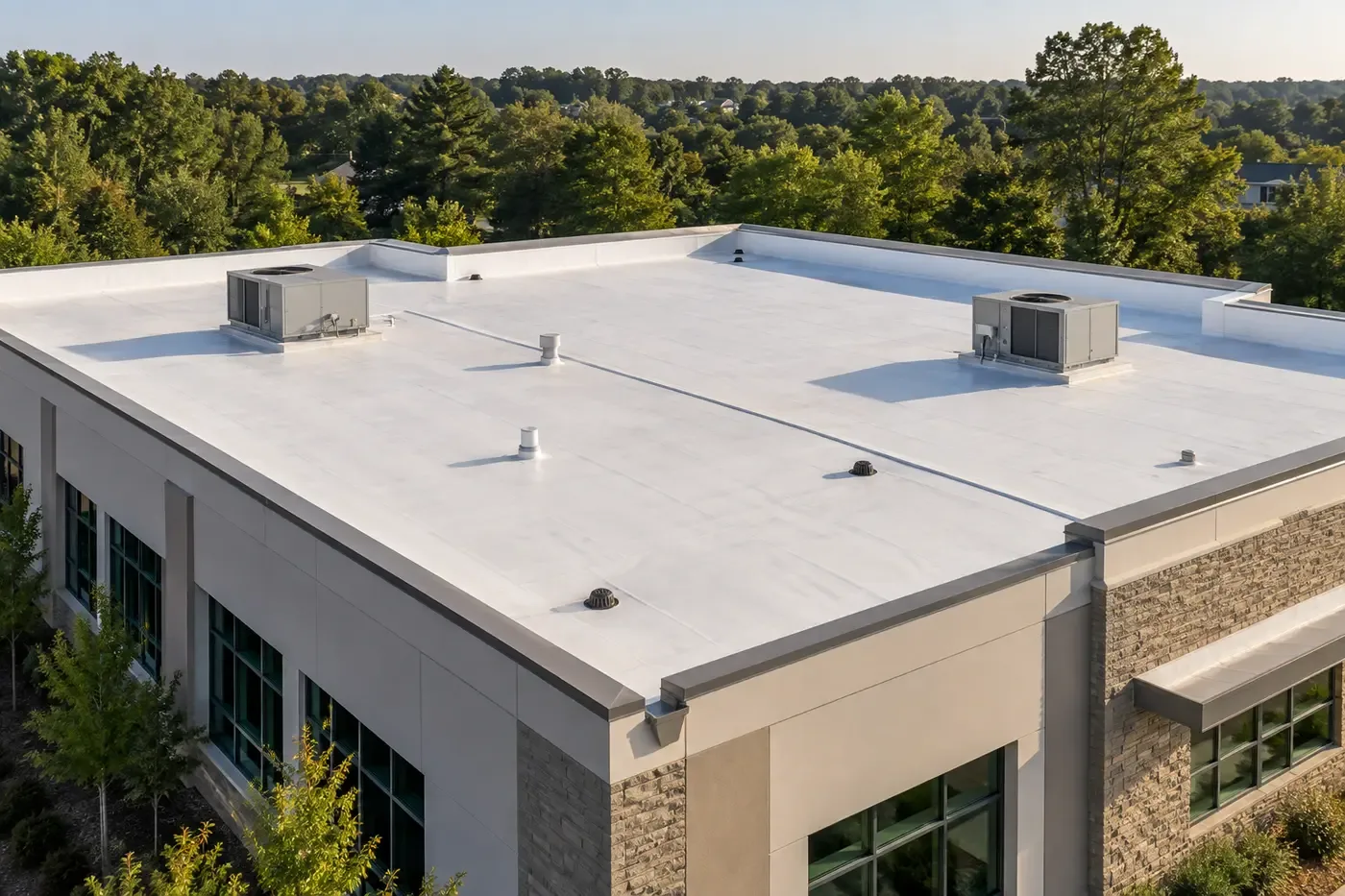
Commercial buildings often have more than one practical roof section. An original building and later addition may have different decks, elevations, insulation, membranes, drainage, or installation dates. Parapets, expansion joints, area dividers, walls, elevation changes, and independent drainage zones can create useful boundaries for investigation and construction.
A line drawn around an interior stain is not a roof section. Water can travel through insulation, along deck flutes, beneath membranes, around curbs, or across structural and drainage transitions before it becomes visible indoors. The scope should begin with a roof plan that names each area and marks drains, scuppers, gutters, walls, curbs, penetrations, rooftop equipment, previous repairs, leak reports, and access limits.
The proposed boundary also needs a buildable transition. New membrane, insulation, cover board, edge metal, flashings, and drainage details must connect to retained work in a manufacturer-compatible way. If the tie-in crosses wet materials, a failing wall detail, an unresolved drainage low point, or several unknown roof layers, the replacement area may need to expand.
Moisture and substrate conditions decide more than appearance
Visual inspection can identify open seams, punctures, splits, displaced flashings, ponding patterns, surface wear, and damaged edges. It cannot by itself map moisture hidden inside insulation or confirm every deck condition. For a major recover or sectional replacement decision, the assessment may need non-destructive moisture scanning, verification cuts, core samples, or other testing selected for the roof assembly.
NRCA’s roof repair and maintenance education specifically includes visual inspections, non-destructive moisture surveys, and core sampling as tools for understanding low-slope assemblies. GAF likewise requires moisture evaluation for eligible commercial recover systems and states that wet roofing materials identified for a TPO-over-TPO recover must be removed and replaced in accordance with its specifications.
Testing results need interpretation, not just colored scan images. Mark suspect areas on a roof plan, verify representative locations, record the roof layers found, and connect the results with leak history, drainage, deck observations, and membrane condition. The goal is to distinguish an isolated wet section from scattered or widespread conditions that a narrow project would leave behind.
Check drainage, rooftop work, warranty, and building operations
A partial replacement should not preserve the reason the section failed. Inspect drain locations and elevations, scuppers, gutters, tapered insulation, crickets, overflow paths, and recurring ponding before reproducing the existing layout. When water repeatedly returns to the same low area, the scope should say whether it is correcting drainage, repairing a membrane, replacing wet materials, or referring a design or structural question for qualified evaluation.
Rooftop equipment can define or complicate the work. HVAC curbs, gas and electrical penetrations, solar attachments, exhausts, supports, and service traffic all affect membrane transitions and scheduling. The proposal should identify which trades disconnect, lift, protect, or reconnect equipment and who checks the roof after their work. Never let an undefined “by others” note hide a critical curb or penetration detail.
Read the current manufacturer guarantee, contractor warranty, maintenance records, and notification requirements before disturbing covered work. A new section does not automatically extend coverage to retained sections, and a partial project does not automatically preserve or void existing coverage. Get the treatment of old work, new work, transitions, authorized repair methods, inspections, and closeout documents in writing from the responsible parties.
For an occupied Indian Trail or Union County building, also plan access, odors, noise, weather protection, debris control, interior monitoring, tenant communication, and emergency dry-in. A technically sound roof scope still needs an operating plan that protects the people, inventory, equipment, and services below it.
When a partial replacement is reasonable—and when it is not
A partial replacement is easier to justify when one defined roof section has a confirmed problem, the remaining sections are dry and serviceable, the deck can support the selected system, drainage can be restored, and the new-to-old transition has an approved detail. It can also make sense when additions or roof areas were installed at different times and already function as separate assets.
A full replacement becomes more practical when moisture or deck deterioration is widespread, leaks recur across several zones, membrane or flashing failure is distributed, the retained areas have little useful life, or repeated partial projects would duplicate mobilization and transition work. Replacement may also be the clearer choice when code, energy requirements, wind-uplift design, manufacturer eligibility, or major rooftop changes cannot be handled responsibly within the smaller boundary.
The written recommendation should compare the real alternatives: focused repair, partial tear-off and replacement, recover or coating when eligible, and full replacement. For each option, state the roof area, evidence, assumptions, exclusions, remaining risks, expected disruption, warranty path, and next capital event. Avoid unsupported service-life promises or universal percentage rules.
Kaliber Roofing serves Indian Trail first with photo-documented commercial roof inspections and same-day or next-day availability subject to scheduling. The same repair-first principle in today’s guide to a creased residential shingle applies at a broader scale: localized damage does not automatically prove an entire roof has failed, but the smallest responsible scope must restore every affected layer and tie into sound surrounding work.
Related guidance
Common questions
Can wet insulation be left under a new commercial roof section?
Wet or deteriorated roofing materials should not be knowingly trapped beneath new work. The assessment should map and verify suspect moisture, define the removal boundary, and follow the selected manufacturer, design, warranty, and project requirements for replacing affected materials.
Is a partial roof replacement the same as a roof recover?
No. A partial replacement removes and rebuilds a defined section to the specified layer or deck. A recover retains eligible existing roof materials and installs an approved new system over them. Both require condition, moisture, structural, drainage, code, and manufacturer review.
Will a manufacturer warranty cover only the new commercial roof section?
Coverage depends on the exact manufacturer program, assembly, contractor authorization, inspections, registration, and written terms. Do not assume new coverage extends to retained roof areas or that existing coverage remains unchanged. Get the boundaries and transition treatment in writing.
What should a partial commercial roof proposal include?
It should include a roof map, existing assembly, test findings, removal depth, replacement materials, deck and wet-insulation process, drainage work, transition details, rooftop-equipment coordination, occupied-building protection, schedule, price, changes, warranties, photos, and closeout requirements.
Sources and editorial notes
- GAF guidance on evaluating commercial roofs for recover, including moisture, structure, roof layers, slope, and repairs
- NRCA roof repair and maintenance guidance on low-slope assemblies, visual inspection, moisture surveys, and core sampling
- GAF case study documenting section-by-section moisture evaluation, tear-off, replacement, and recover decisions
Prepared with AI assistance and editorially reviewed by Sage. General property-maintenance guidance; not an on-site diagnosis, moisture survey, structural conclusion, warranty or code determination, project design, or substitute for the roof manufacturer, warranty provider, qualified roofing professional, or building-design professional.