Yes—damaged hip cap shingles can often be replaced as a focused roof repair when the problem is limited, the roof deck and underlayment at the hip remain sound, and the field shingles on both adjoining roof planes can be worked without breaking. A complete repair does more than fasten one loose cap back down. It should open enough of the hip to identify the first and last affected pieces, inspect the shared hip line and adjacent shingle edges, restore any disturbed underlayment and fasteners, and install compatible cap shingles in the correct bottom-to-top overlap. Broader work may be needed when damage continues along much of the hip, the underlying deck is weak, nearby field shingles are brittle, or several roof lines show the same fastening or wind-lift problem.
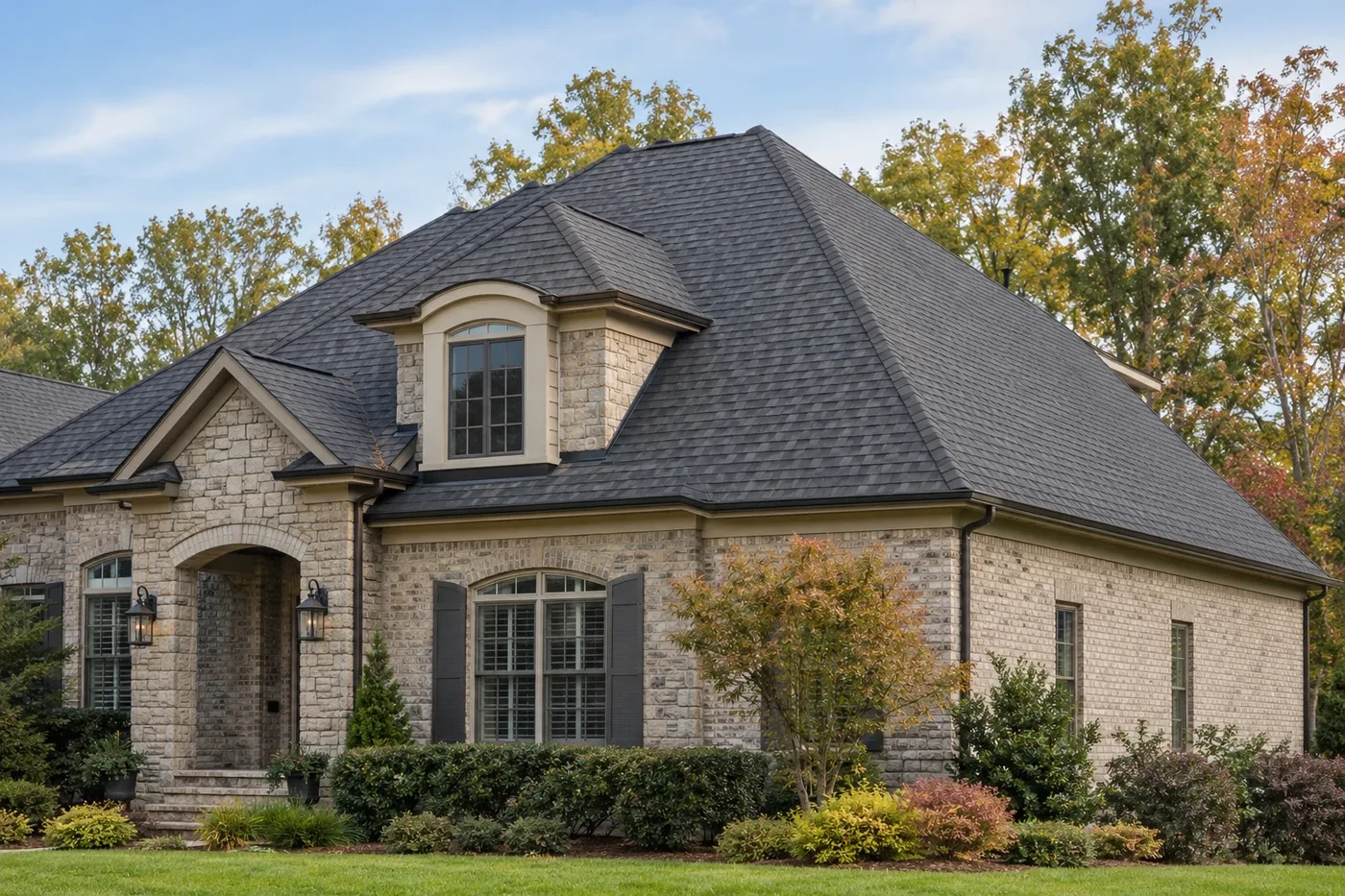
A roof hip is not the same detail as a horizontal ridge
A roof hip is the sloping outside line where two roof planes meet. Water moves away from that raised line onto both planes, and the cap shingles run uphill from the eave toward the ridge. A ridge is usually horizontal and may include an exhaust vent beneath its caps. The materials can look similar, but the direction of installation and the connected roof details are not identical.
Owens Corning’s ProEdge instructions specify that hip shingles begin at the bottom of the hip and continue upward, with each new cap overlapping the one below. The instructions also say hips are completed before ridge caps. That sequence matters at the upper intersection: a repair cannot leave the final hip caps reverse-lapped beneath an incorrect ridge termination.
This is the practical reason a photo of one lifted cap is not the full diagnosis. The roofer should identify whether the visible piece is loose, creased, torn, punctured, poorly fastened, or simply part of a longer run that has shifted. The lowest affected piece controls where the repair must begin so the replacement caps can shed water in the original direction.
The repair boundary should include both adjoining roof planes
Hip caps cover a joint shared by two roof planes. Removing them exposes the upper edges of field shingles, fasteners, underlayment, and the roof deck on both sides. A dependable scope should therefore inspect both planes instead of treating the cap as decorative trim attached to only one slope.
GAF’s technical guidance for work at a hip explains that cap shingles must be carefully removed and that underlayment at the hip needs a continuous, properly overlapped transition between the roof planes. When nails are removed from shingles that remain, they must be replaced in appropriate locations, abandoned holes addressed, and broken shingle seals restored according to the applicable product instructions.
For a small repair, that may mean removing several caps above and below the visible defect, checking the field-shingle corners and deck along the opened line, then rebuilding the underlayment transition and cap sequence. If opening the hip reveals torn membrane, enlarged fastener holes, soft sheathing, or damage extending into field shingles, the boundary should expand only far enough to reach sound materials on both sides.
Resealing is appropriate only when the cap itself is still sound
An intact cap that has lost its bond may sometimes be hand-sealed when its position, fasteners, exposure, and surrounding materials are otherwise correct. That is different from a cap that has folded in the wind, split at the bend, torn around a nail, slid out of alignment, or lost material. Adhesive cannot restore a damaged shingle body or a fastener hole that no longer holds.
ARMA explains that asphalt-shingle components can often be repaired independently because sealed shingles can be carefully separated and restored within a limited area. It also warns against treating temporary roofing cement over damaged material as a permanent repair. The installed shingle manufacturer’s current directions should govern the replacement cap, fastening, exposure, and any required hand sealing.
Product compatibility matters too. Hip and ridge caps may be purpose-made accessories, field shingles cut into cap pieces where the product allows it, or higher-profile layered products. The repair should identify what is installed before choosing a replacement. A similar color does not prove that the thickness, exposure, bending characteristics, or fastening requirements match.
Photos should show why the repair stops where it does
Ask for one wide photo that identifies the full hip, middle-distance photos that show the affected run, and close images of the actual damage. If the line is opened, progress photos should show the deck, underlayment transition, field-shingle edges, fastener locations, and new cap sequence before the completed caps hide those layers.
The written scope should name the cap product or compatible repair material, the approximate repair length, treatment of disturbed shingles and fasteners, and the process for concealed deck or underlayment damage. It should also distinguish the visible defect from conditions that cannot be confirmed until the caps are removed. “Seal loose hip” is not enough detail to compare repair proposals.
Kaliber Roofing serves Indian Trail first with photo-documented, repair-first inspections available the same or next day subject to scheduling. Kaliber provides a one-year warranty for the repair work it performs. That coverage applies to the completed repair—not every unrelated part of the existing roof—and remains separate from manufacturer material warranties. The goal is a clear repair boundary that restores the shared hip line without turning an isolated condition into an unsupported whole-roof conclusion.
Related guidance
Common questions
Can one missing hip cap shingle cause a leak?
It can expose fasteners, field-shingle edges, underlayment, or the shared hip joint to wind-driven rain. Whether water reaches the interior depends on the layers below and the storm direction, so the opening and both adjoining roof planes should be inspected promptly.
Can a loose hip cap simply be nailed back down?
Only if the cap is still sound and the selected product instructions support that repair. A creased, torn, punctured, badly shifted, or enlarged-fastener-hole cap generally needs replacement, with the surrounding overlap and fasteners restored correctly.
Does hip-cap damage mean the ridge vent is damaged?
Not necessarily. Roof hips and horizontal ridges are different lines, and ridge ventilation is normally located at a ridge rather than under a standard hip. The inspection should still check the upper hip-to-ridge intersection when damage reaches that area.
Will new hip cap shingles match the existing roof?
An exact visual match is not guaranteed because the existing roof has weathered and the original product or color lot may have changed. Confirm installation compatibility first, then compare an actual material sample when one is available.
When is hip-cap damage too broad for a small repair?
A larger scope may be justified when caps are failing along much of the hip, both adjoining slopes have brittle or damaged field shingles, the deck or underlayment is weak across a wider area, or similar fastening failures appear on several hips and ridges. The recommendation should be tied to documented conditions.
Sources and editorial notes
- GAF technical bulletin on underlayment transitions and cap removal at hips and ridges during roof repair
- Owens Corning ProEdge hip and ridge cap application instructions
- Asphalt Roofing Manufacturers Association guidance on focused asphalt-shingle repairs
Prepared with AI assistance and editorially reviewed by Sage. General homeowner guidance; not an on-site diagnosis, product-specific installation approval, code or structural determination, insurance coverage decision, or substitute for evaluation by the appropriate qualified professional.