Yes. An upper-roof downspout can wear a narrow path across the shingles below when it concentrates runoff from one roof area onto the lower roof. Look for a track that begins directly under the outlet, but do not assume every dark or bare strip has the same cause. A documented Indian Trail roof-repair inspection should check the complete route—from the upper gutter and outlet to the lower shingles, nearby wall details, lower gutter, and any moisture evidence—before the water is rerouted or roofing is replaced.
The shape of the evidence matters. A downspout problem usually leaves a fairly narrow trail. Broad, even granule loss across a whole slope tells a different story. So do scattered impact marks after hail.
Stay on the ground for the first look. Wet shingles, steep roofs, and upper gutters are not safe homeowner inspection areas. If water is active near a light, ceiling fan, outlet, or sagging drywall, keep clear and use the appropriate qualified help. This guide is general education, not a diagnosis of your home.
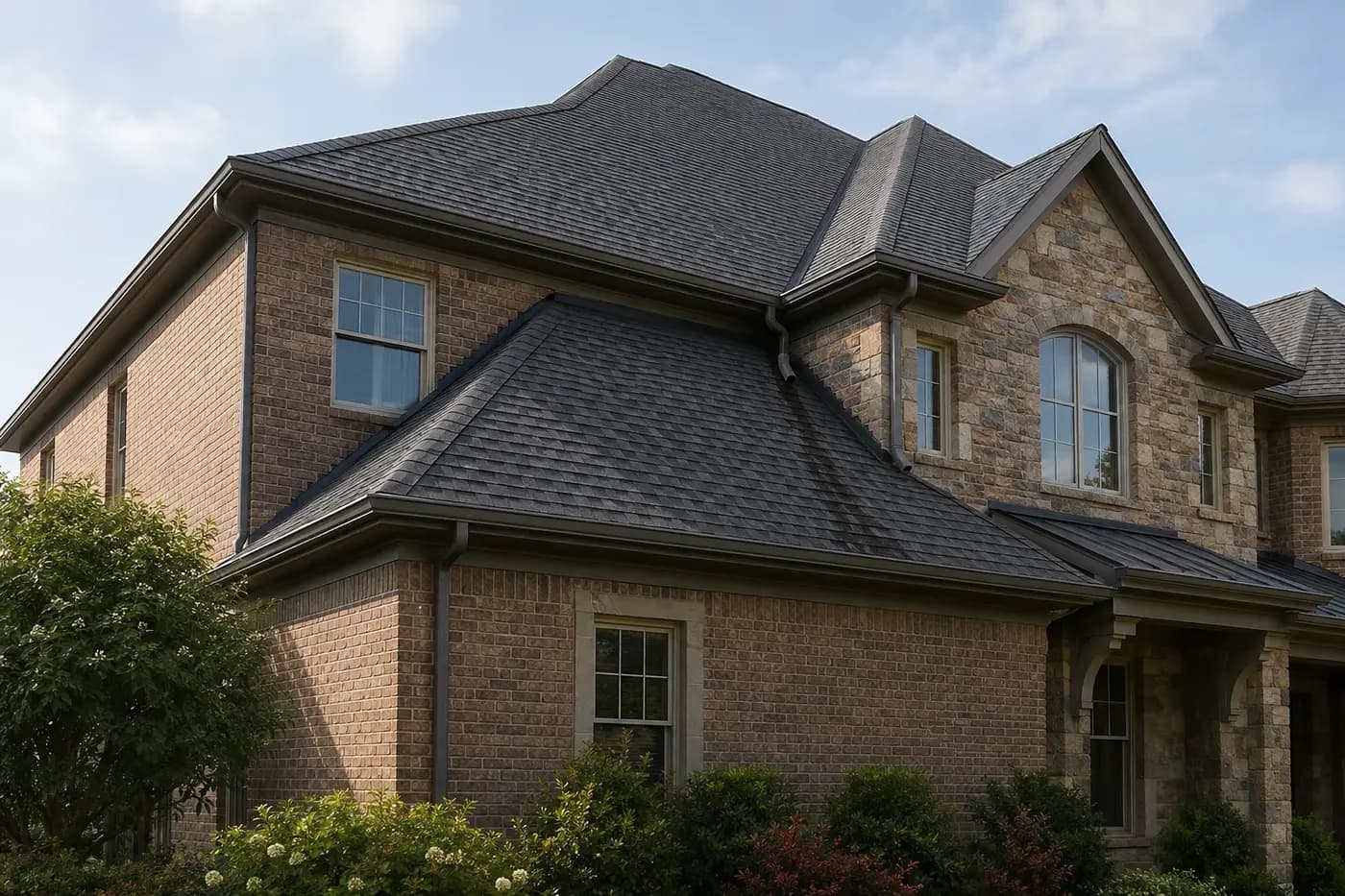
How Can You Spot an Upper-Downspout Wear Pattern?
Begin with one wide photo from dry ground. Include the upper gutter, its outlet, the entire lower roof plane, and the lower gutter. Then use phone zoom for the strip immediately below the downspout. Context first. A close picture of five shingles is hard to interpret when no one can see what drains onto them.
A possible discharge track may look darker because it stays wet longer, lighter because granules have been disturbed, or unusually clean because repeated runoff moves dust and organic debris. Moss or algae may follow the wetter path. Shingle edges can look worn, and exposed asphalt may appear darker than the surrounding granule surface.
Now compare both sides of that strip. Does the change begin exactly at the outlet and continue downslope toward the lower gutter? Is the rest of the roof fairly uniform? Does runoff shoot sideways toward a wall or rake edge during hard rain? A short video from a protected ground-level location can be useful. Do not stand under overflowing gutters during lightning, high wind, or falling debris.
Inside, note any stain or damp insulation below the track only from a safe access point. Water can move along decking and framing before it appears, so an indoor mark does not have to sit directly below the outlet.
Why Does Concentrated Runoff Matter?
A lower roof is already handling the rain that lands on it. An upper downspout adds collected water from another roof section to one small release point. That does not guarantee damage, but it changes the amount and concentration of water crossing the shingles below.
The U.S. Department of Energy's Building America Solution Center describes gutters and downspouts as a connected system that collects roof runoff and conducts it through a planned drainage path. Owens Corning likewise explains the intended sequence: rain moves down the roof slope into gutters, then away through downspouts. When an upper outlet stops halfway and releases onto another roof, the lower shingles become part of that concentrated conveyance path.
Asphalt shingles shed water through overlapping courses. Their mineral granules protect the asphalt surface, while underlayment and sound decking form the layers below. Repeated discharge can create localized surface wear or keep one strip wetter than neighboring shingles. InspectAPedia documents early shingle wear, staining, organic growth, and possible leaks where upper-roof drainage spills across a lower roof slope.
Still, avoid the pressure-washer analogy as a diagnosis. Water volume, outlet height and direction, roof pitch, shingle condition, wall proximity, lower-gutter capacity, and years of exposure all affect what happens. The actual material condition has to be inspected.
What Else Could Cause a Dark or Worn Strip?
Not every streak below a downspout is damage from the downspout. Shade can slow drying. A nearby valley can deliver extra runoff. Leaves may collect where two roof planes meet. A past shingle repair can weather at a different rate, and algae can follow moisture without proving that shingles have lost their water-shedding function.
Storm evidence also needs its own pattern. Hail-related marks are usually evaluated across representative roof areas and other exposed materials, not declared from one straight track below an outlet. Normal aging is often broader. Kaliber's guide to roof granules collecting in gutters explains why timing, amount, and roof condition matter before a cause is assigned.
Wall details can complicate the picture too. If the upper downspout ends near siding, a dormer, or a roof-to-wall intersection, splash can reach flashing or cladding. The lower gutter may also overflow or let water run behind it. That is why this inspection cannot stop at the visibly discolored shingles.
What Should an Indian Trail Inspection Check?
The upper system comes first: gutter pitch, outlet connection, debris, seams, fasteners, downspout joints, and the direction and height of discharge. The report should identify the roof area feeding that outlet rather than treating the downspout as an isolated pipe.
Next comes the lower roof. Photos should show the full track and close details of granules, shingle edges, seals, fasteners, soft spots, prior repairs, nearby valleys, and roof-to-wall transitions. If moisture is suspected below, accessible attic evidence or carefully planned limited opening may be needed. No one should promise the condition of concealed underlayment or decking without seeing enough evidence.
Then check the receiving gutter and discharge path. Can the lower gutter accept the added upper-roof water? Would a connected extension interfere with drainage, flashing, shingles, or maintenance? Does the water ultimately move away from the building through an appropriate route? The correct layout is specific to the house and should follow current product instructions and applicable requirements rather than a generic internet sketch.
Kaliber's Indian Trail gutter-repair service covers this connected-system review. The goal is a written explanation of what is observed, what remains hidden, which drainage change is proposed, whether roofing beneath it needs repair, and where each repair boundary ends.
What Does a Responsible Repair Involve?
Think of this as two linked decisions. First, establish a durable path for upper-roof runoff. Depending on the actual geometry, that may involve correcting an outlet or downspout connection and conducting the water to a receiving gutter or another approved discharge route. The plan also has to account for the lower gutter's capacity and the way the extension is supported without creating new roof penetrations or interfering with flashing.
Second, evaluate the lower roof on its own condition. Cosmetic discoloration may call for monitoring once drainage is corrected. Localized shingles that have lost protective granules, seals, or sound edges may need focused replacement. Wet or weak decking must be addressed if inspection confirms it. Rerouting the downspout does not rebuild damaged roofing, and replacing the visible shingles without changing a harmful discharge path can set up the same problem again.
A full replacement should not come from one streak alone. Broader work needs broader evidence: widespread brittle or failing shingles, damage across multiple roof areas, repeated leaks, extensive decking trouble, or no sound material available for a reliable local tie-in. Repair first when a focused repair is supportable.
For homeowners near Indian Trail, Stallings, Monroe, Matthews, and Wesley Chapel, Kaliber can inspect the roof and drainage path with photos, then explain the smallest responsible scope. Same-day or next-day inspections are available subject to current scheduling.
See a worn track below an upper downspout?
Kaliber Roofing can document the upper outlet, lower roof, gutter capacity, and moisture evidence before recommending a repair.
Schedule a Free Roof InspectionSources and Limits
This guide uses current water-management guidance from the U.S. Department of Energy's Building America Solution Center gutter and downspout guide, its asphalt-shingle roof guide, Owens Corning's roof water-management guidance, and the documented upper-to-lower roof condition in InspectAPedia's downspout defect reference. Kaliber Roofing is the organizational author and reviewer; no individual credential or firsthand claim about a specific property is presented here.
This article is general education. It is not a diagnosis, structural opinion, code or permit ruling, warranty decision, drainage design for a particular home, or substitute for an on-site inspection by a qualified roofing professional. Product instructions and site conditions differ. Use the appropriate qualified professional when structural, electrical, wall, foundation, or concealed moisture conditions may be involved.
Frequently Asked Questions
Is it wrong for an upper downspout to empty onto a lower roof?
The arrangement deserves inspection because it concentrates runoff from one roof area onto a narrow strip of lower roofing. The responsible correction depends on the roof geometry, drainage capacity, wall details, materials, and a safe route to a lower gutter or approved discharge point. A photo alone cannot establish the right layout for a specific home.
What does downspout damage look like on asphalt shingles?
Possible clues include a narrow discolored or cleaner-looking track below the outlet, localized granule loss, exposed darker asphalt, moss or algae that follows the water path, worn shingle edges, staining near a sidewall, or moisture below that strip. Those clues are not proof by themselves; aging, debris, hail, past repairs, and other drainage problems can look similar.
Will extending the downspout fix the damaged shingles?
Rerouting the water may stop continued concentrated discharge, but it does not restore granules, seals, underlayment, or decking that are already damaged. The drainage path and the lower roof condition should be evaluated separately, then corrected as one coordinated scope.
Does a worn strip below a downspout mean I need a new roof?
Not automatically. A focused repair may be responsible when wear is localized and the surrounding shingles, underlayment, decking, flashing, and drainage system remain serviceable. Broader work should be based on roof-wide condition, not one runoff track.
Can I inspect the downspout from the ground?
Yes. From dry ground, use phone zoom to photograph the upper gutter outlet, the full lower-roof track, nearby walls or valleys, and the lower gutter. Do not climb onto a wet or steep roof or lean a ladder against a questionable gutter. An on-roof conclusion belongs to a qualified professional using appropriate access and safety equipment.
How quickly can Kaliber inspect this in Indian Trail?
Kaliber Roofing offers same-day or next-day inspections subject to current scheduling. Mention active interior water, sagging drywall, or water near electrical fixtures when you call so the immediate safety and protection needs can be prioritized.