Yes, a shingle-to-metal roof transition can often be repaired without replacing both complete roof sections when the leak is confined and the surrounding shingles, metal panels, decking, and underlayment remain serviceable. The repair usually needs to open the joint far enough to identify the failed layer, rebuild compatible transition flashing, restore the water-shedding laps, and reconnect both roof coverings according to their product requirements. A bead of sealant across the visible seam is not a substitute for failed flashing or hidden wet materials.
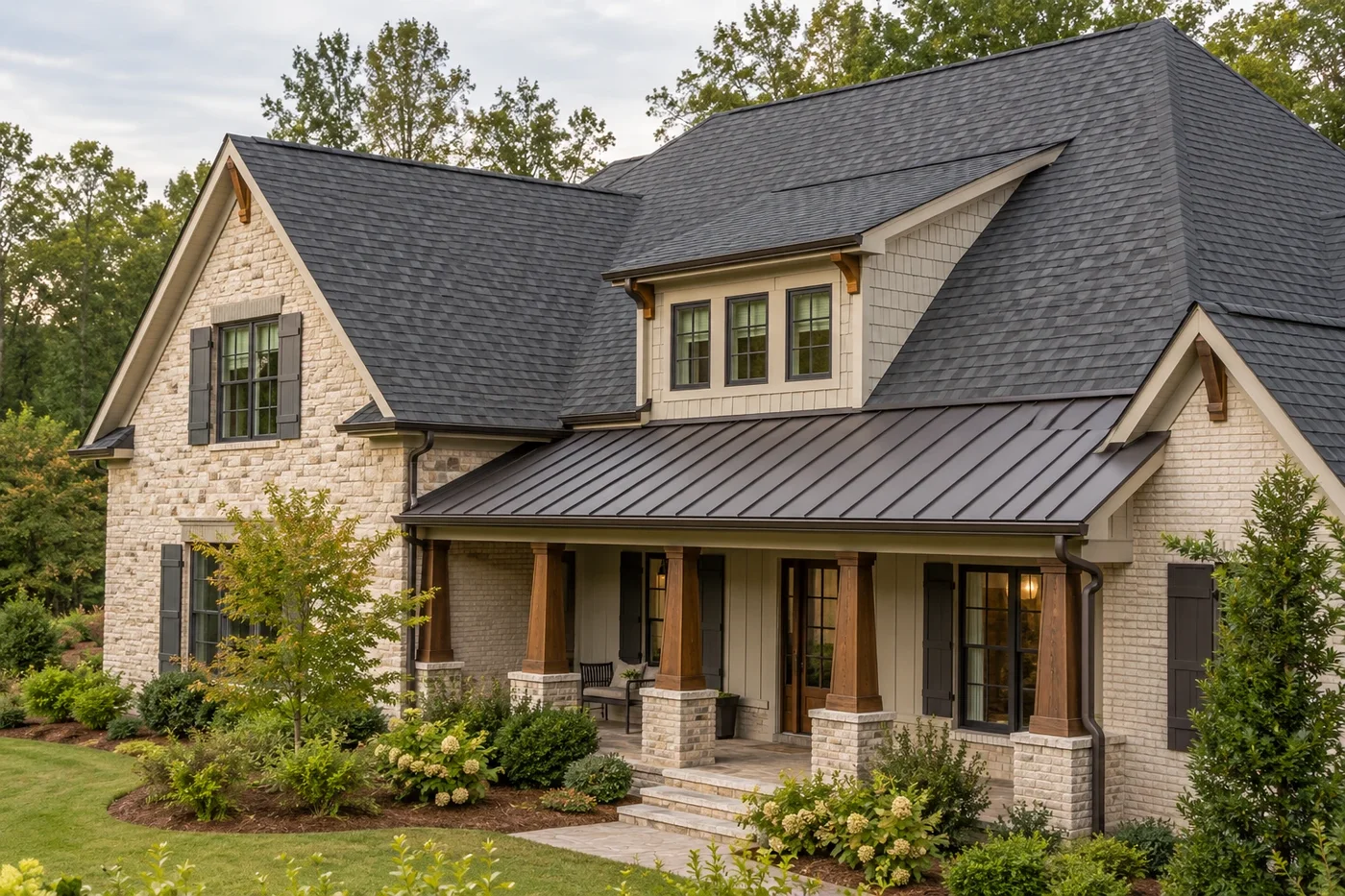
Treat the transition as one assembly, not two unrelated roofs
Mixed-material roofs often appear where a shingle-covered main house meets a metal porch, addition, bay, or lower-slope section. Water reaching that boundary must leave the upper roof, cross the change in material or pitch, and continue over the lower covering without reaching an exposed edge, fastener, panel rib, or concealed lap.
North Carolina residential code requires flashing where roof slope or direction changes and requires roof materials to be compatible. The repair question is therefore not simply whether the shingles or metal look damaged. It is whether the complete connection still directs water downhill while allowing each roof covering to perform as designed.
Find which layer failed before choosing the repair boundary
A ceiling stain near the joint does not identify the entry point by itself. Water may enter through short or displaced transition flashing, a puncture, an open flashing end, a loose panel or shingle, deteriorated underlayment, a failed closure used with a profiled panel, or another detail farther upslope. It can then travel along decking or framing before becoming visible indoors.
Document when the leak appears, the wind direction if relevant, and the first wet location that can be seen safely. The exterior inspection should show the full transition and both roof planes, while accessible attic evidence can help connect the interior moisture path to the roof geometry. Uncontrolled hose testing or walking on a wet metal roof can create additional risk and should not be a homeowner diagnostic shortcut.
A dependable repair usually requires opening both sides of the joint
The upper shingle courses may need to be carefully released so the top leg of the flashing, underlayment, fasteners, and deck can be inspected. On the metal side, the scope may need access to the panel ends, transition trim, clips or fasteners, closures, sealant locations, and the lower water-exit path. The exact sequence depends on the identified products and roof geometry.
The goal is a layered repair, not a surface bridge. New flashing must be shaped and lapped so runoff moves over the transition and onto the lower roof. Disturbed shingles must be refastened and sealed as their instructions require. Metal-roof components must remain compatible with the panel profile and allow for the movement contemplated by that system. Sealant can support specified joints, but it should not replace missing laps, metal, underlayment, or sound decking.
When a focused repair can become a wider rebuild
A limited repair is more practical when the leak is tied to one defined joint, adjacent shingles can be opened without breaking, the metal panels and edges are sound, and the deck provides a dry, stable base. The work may remain concentrated around the transition even if several courses or part of a panel must be opened to rebuild it correctly.
The scope can grow when corrosion or punctures continue across the metal, shingles are broadly brittle, panel ends were cut too short, the existing transition lacks a workable flashing path, decking is wet or deteriorated, or the lower roof pitch and selected covering are incompatible. Those findings do not automatically require replacing every roof plane, but they do require a boundary that ends in sound, product-compatible material.
What an Indian Trail transition-repair scope should state
Ask the proposal to identify both roof coverings, the suspected entry point, the section being opened, transition-flashing material and shape, underlayment and decking work, shingle handling, metal-panel or trim handling, closure and sealant requirements where applicable, concealed-condition pricing, appearance limits, cleanup, photographs, and warranty terms. If the products cannot be identified before opening the roof, the estimate should say how compatibility will be confirmed before the joint is rebuilt.
Kaliber Roofing provides a one-year warranty for the repair work it performs. That applies to the defined repair scope, not every unchanged part of either roof section. Same-day or next-day inspections are available subject to scheduling, and the recommendation should distinguish a permanent transition repair from temporary weather protection or a broader roof project.
Related guidance
Common questions
Can roof cement permanently fix the seam between shingles and metal roofing?
Not when the transition flashing, underlayment, decking, shingles, or metal components have failed. A compatible sealant may belong at specific joints required by a roof system, but a surface coating does not recreate missing flashing or a correctly layered water path.
Does the entire metal porch roof have to be removed for a transition repair?
Not automatically. The responsible opening depends on the panel system, fastening method, location of the failed joint, and whether the transition can be accessed and rebuilt without damaging retained panels. The estimate should define that access before work begins.
Can the asphalt shingles stay during the repair?
Some shingles may remain, but the courses directly above or beside the transition often need to be released or removed to inspect concealed layers and install flashing in the proper sequence. Shingles damaged during access or unable to reseal reliably should be replaced.
Does one leak at the transition mean both roof sections need replacement?
No. One localized failure may support a focused repair when both surrounding roof coverings and the deck remain serviceable. Broader replacement becomes more reasonable only when deterioration, incompatibility, or the absence of a dependable stopping point extends beyond the joint.
Sources and editorial notes
- 2018 North Carolina Residential Code Chapter 9: flashing locations, material compatibility, and manufacturer instructions
- ARMA: asphalt-shingle repairability, opening sealed courses, and avoiding temporary surface fixes
- Metal Construction Association metal roof installation manual: flashings, sealants, panel details, and repair planning
Written from the governing North Carolina residential-code chapter, current trade-association guidance, and Kaliber’s verified service and warranty information. Prepared with AI assistance and editorially reviewed by Sage. No human approval is claimed. General homeowner guidance; not a code, structural, product-compatibility, or repair decision for a specific roof.