Roof pitch affects how quickly water drains, which roofing details and underlayment rules apply, and how a crew can safely reach and open the repair area. It can change the size and method of a repair, but pitch alone does not decide whether a roof should be repaired or replaced. The contractor should measure the affected slope, identify the installed roof covering, check the applicable product instructions, and define how new materials will tie into the existing water-shedding layers.
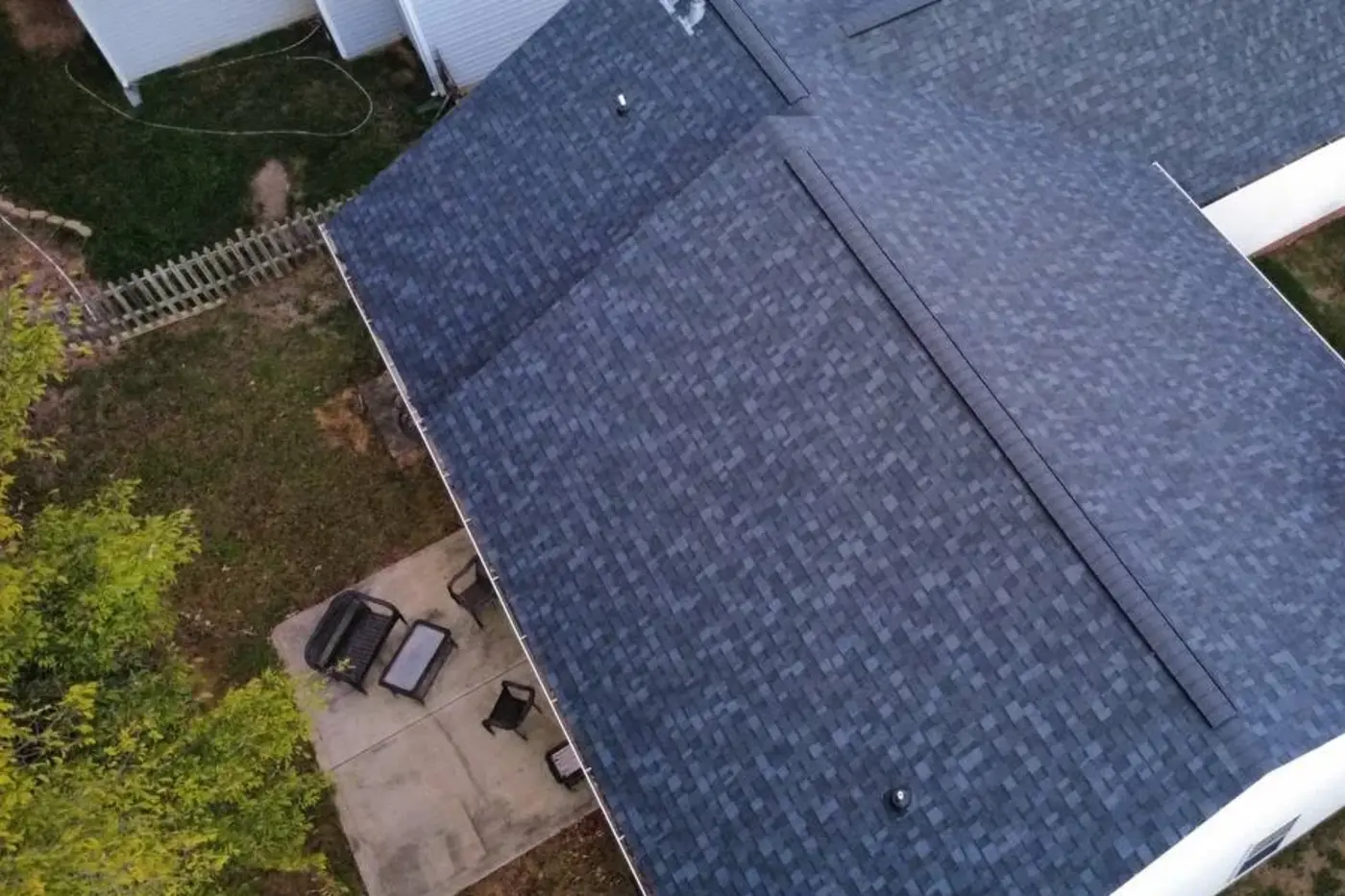
Roof pitch is a measurement, not a repair verdict
Pitch describes vertical rise over horizontal run. A 4:12 roof rises four inches for every 12 inches of horizontal distance. That measurement helps identify the roof-covering rules and access plan that apply to a particular slope. It does not reveal whether shingles are brittle, flashing is failed, decking is soft, or a leak is isolated.
Two Indian Trail roofs can have the same pitch and need different work. One may have a single repairable pipe-boot leak surrounded by sound shingles. The other may have repeated failures and damaged decking across several planes. The inspection still has to document the condition, moisture path, surrounding materials, and dependable repair boundary.
Lower slopes need closer attention to the layers below the shingles
Water generally leaves a steeper roof faster. On a lower slope, runoff moves more slowly and wind-driven rain has more opportunity to work across shingle overlaps. That is why the exact product instructions matter. Current GAF Timberline instructions permit those shingles on slopes of 2:12 or greater and call for a different roof-deck-protection arrangement from 2:12 to less than 4:12. Current Owens Corning Duration Storm instructions likewise distinguish low slopes from standard slopes and specify additional underlayment overlap or a self-adhered barrier option.
For a repair, the visible shingle is only the top layer. If a low-slope section was built with extra underlayment coverage or a self-adhered membrane, the opening may need to be large enough to restore that concealed layer in the correct overlap. Covering the surface with cement does not recreate a failed underlayment tie-in. A slope below the selected shingle system’s permitted range may need a different roof-covering solution rather than another shingle patch.
Steeper pitch changes access and safety, not the severity of the defect
A small defect does not become roof-wide damage because it sits on a steep plane. It can still support a focused repair when nearby shingles, underlayment, flashing, and decking remain serviceable. The difference is that access, fall protection, material handling, and the sequence for opening bonded shingle courses may be more demanding.
OSHA defines a steep roof for its construction fall-protection rules as a roof with a slope greater than 4:12. Federal requirements address how workers must be protected when working above lower levels; homeowners should not use that threshold as a reason to climb onto a 4:12 or lower roof. A wet, damaged, high, or complex roof can be unsafe at any pitch. Ground photos, attic evidence, drone views, or a return visit under suitable conditions may support the inspection without turning unsafe access into guesswork.
Pitch also changes the details around transitions and valleys
Many Union County homes combine a main roof with porch, garage, dormer, or addition slopes. The measured pitch can change from one plane to the next. Where those planes meet, the repair must preserve a continuous downhill path through shingles, underlayment, valley material, transition flashing, wall flashing, and roof edges as applicable.
That is different from saying every mixed-pitch roof has a problem. The practical question is whether the damaged area can be opened and rebuilt to the instructions for that exact roof section. A leak where one slope changes into another deserves its own transition diagnosis. A repair in the open field of one plane may have a simpler boundary.
What a pitch-aware roof repair scope should show
Ask the repair scope to identify the affected plane and measured pitch, the existing roof covering, the suspected failure, the courses or details that must be opened, and the underlayment, flashing, decking, fasteners, seals, and compatible shingles expected in the repair. If a low-slope assembly or shared transition is involved, the proposal should explain how concealed layers will be restored and how hidden damage will be handled before it is covered again.
Material compatibility still matters after pitch is measured. Today’s guide to using 3-tab shingles on an architectural roof explains why color and the word “asphalt” do not prove that a replacement fits the installed field shingles. Kaliber Roofing offers same-day or next-day inspections subject to scheduling and can document the roof pitch, affected components, and smallest responsible repair scope for an Indian Trail home.
Read why a 3-tab shingle is usually not a direct substitute for an architectural field shingle.
Related guidance
Common questions
Does a steep roof always cost more to repair?
Do not assume a price from pitch alone. Access, height, repair location, material condition, opening size, flashing, decking, safety setup, and concealed damage all affect the scope. Compare written repair boundaries rather than one pitch label.
Can asphalt shingles be used on a 2:12 roof?
Some asphalt-shingle products permit installation at 2:12 when their low-slope instructions are followed, while requirements vary by product and applicable code. Confirm the exact shingle and underlayment instructions instead of applying a universal rule.
Does a low pitch automatically cause roof leaks?
No. A correctly designed and installed low-slope assembly can perform as intended. Problems arise when the roof covering is unsuitable for the slope, concealed layers or transitions are wrong, drainage is obstructed, or materials are damaged.
Can roof pitch be estimated from the ground?
A ground view can suggest that one section is steeper than another, but a repair decision should use a documented measurement or reliable roof record. Perspective and complex roof geometry can make visual estimates misleading.
Does Kaliber repair steep and low-slope roof sections in Indian Trail?
Kaliber Roofing evaluates the roof covering, measured slope, access, surrounding materials, and connected details before recommending a repair. The inspection determines whether the affected assembly supports a dependable focused repair or needs a different scope.
Sources and editorial notes
- GAF: Timberline LayerLock installation instructions
- Owens Corning: Duration Storm installation instructions
- OSHA: duty to have fall protection
- ARMA: asphalt shingle roofs are repairable
Written from manufacturer installation guidance, federal safety guidance, industry repair guidance, Kaliber’s verified service information, and an actual Kaliber project image. Prepared with AI assistance and editorially reviewed by Sage. No human approval is claimed. General homeowner guidance; not a diagnosis, safety plan, code decision, or product-specific repair instruction for a particular roof.