Yes. A chimney cricket can contribute to a roof leak when its shingles or metal covering are damaged, its ridge is too low or deformed to split runoff, its flashing has opened, or its side transitions no longer direct water onto the main roof. Leaves and shingle granules can also collect around a poorly draining cricket and hold water against the uphill side of the chimney. The right repair is not simply more caulk: the roofer should inspect the cricket shape, covering, underlayment, decking, saddle or back-pan flashing, side transitions, counterflashing, and interior water path as one assembly. When the defect is isolated and the surrounding roof remains serviceable, a focused chimney-cricket repair may be enough without replacing the whole roof.
What a chimney cricket is supposed to do
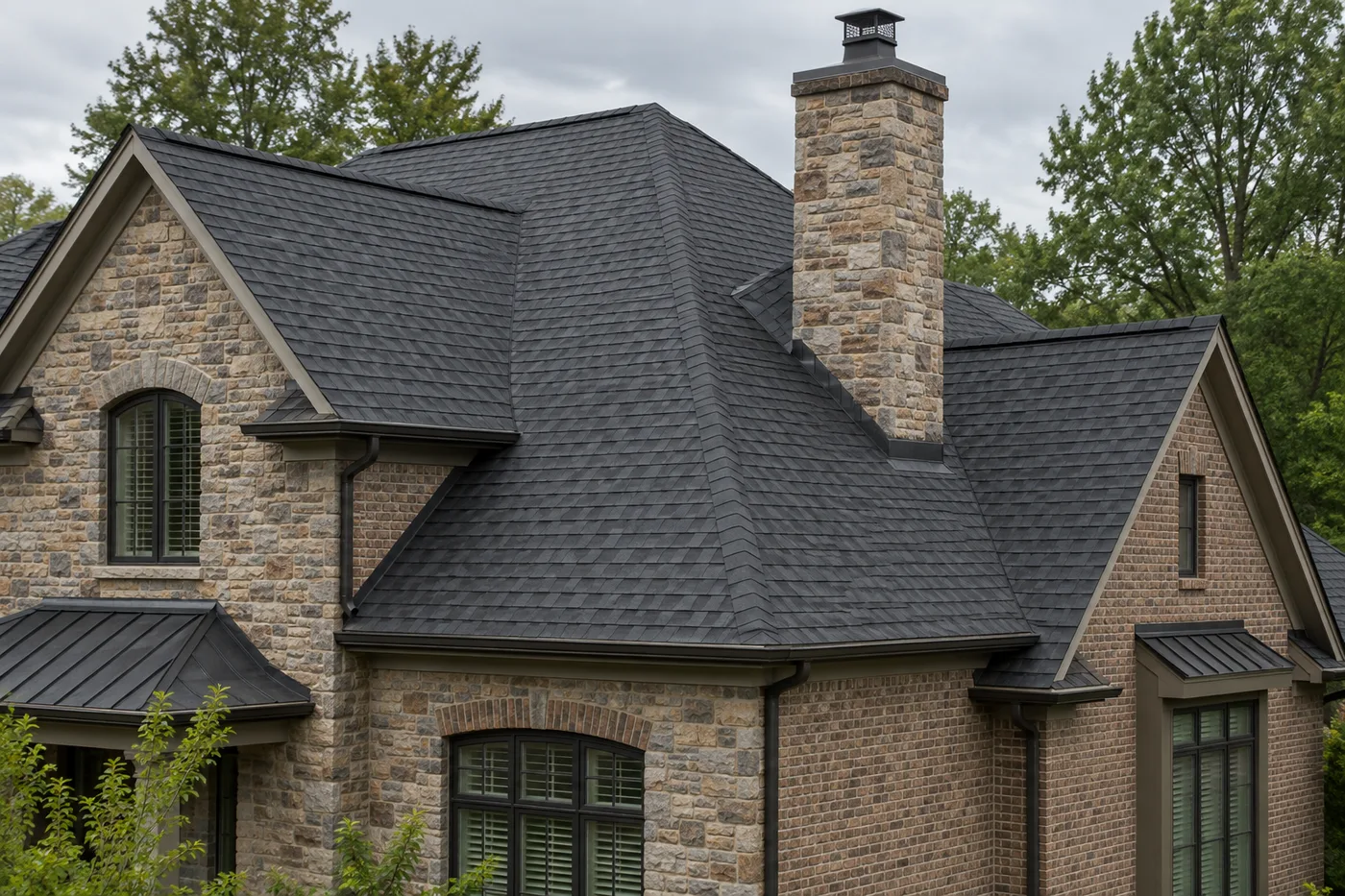
A chimney interrupts water moving down a sloped roof. On the uphill side, runoff reaches a vertical wall and has to turn toward one side or the other. A cricket—also called a saddle—is the small peaked roof built behind the chimney to split that flow before it piles against the masonry.
The cricket is not one piece of decorative trim. It has shape, structure, a roof or metal covering, and flashing connections. Water has to move over its two faces, around its side valleys or transitions, and back onto the main roof without crossing beneath shingles or flashing. GAF describes sloped-roof crickets as triangular water diverters used behind chimneys and other wide roof obstructions.
That focus makes a cricket leak different from a general chimney-flashing problem. The chimney still needs apron flashing on the downhill face, step flashing along the sides, and counterflashing at the masonry. The cricket adds another small roof intersection on the uphill side. A defect in any one of those connected parts can produce a stain near the same chimney chase.
When North Carolina code calls for a cricket or saddle
The 2024 North Carolina Residential Code states that a cricket or saddle must be installed on the ridge side of a chimney or penetration more than 30 inches wide, measured perpendicular to the roof slope. The covering must be sheet metal or the same material as the roof covering. That is a clear statewide code provision for work governed by that code edition.
The measurement and the condition still need to be confirmed on the actual roof. Homeowners should not decide from a front-yard photo that a cricket is missing or noncompliant. Roof pitch, chimney orientation, construction date, permit scope, adopted code at the time of work, local interpretation, and any later alterations can affect a project-specific determination.
Even where a chimney is narrower than the stated threshold, an existing cricket can still leak if its covering or flashing fails. Conversely, seeing a cricket does not prove that every surrounding detail is correct. The practical inspection question is whether the full uphill assembly moves water around the chimney and ties into sound roofing.
How a chimney cricket can start leaking
Start with the cricket covering. Shingles can crack, lift, lose their bond, or be fastened where concentrated runoff reaches the nail. A sheet-metal cricket can develop open seams, corrosion, punctures, or distorted edges. Either covering can fail where it meets the main roof if laps face the wrong direction or repairs leave exposed fasteners in the drainage path.
Next is the shape. A low, flattened, sagging, or uneven cricket may slow water instead of dividing it cleanly. Debris then gathers at the ridge, along the chimney, or in the side transitions. Leaves, pine needles, and shingle granules do not create every leak, but they can hold moisture and redirect hard rain toward a weak seam.
Flashing is often the hidden part of the failure. The cricket needs to connect with the chimney flashing and the main roof without a break in the downhill overlap. GAF’s published chimney-cricket detail shows cricket flashing extending upslope on the roof deck and up the back of the chimney. If the saddle or back-pan flashing is short, split, reversed, detached, or buried under old cement, water can pass beneath the visible covering.
The deck and underlayment matter too. Repeated wetting can soften or delaminate the small deck beneath the cricket and the roof immediately beside it. A surface bead may slow one seam while damaged wood and an open hidden lap continue to move water toward the attic.
Clues that point to the uphill side of the chimney
Inside, document the first place moisture appears around the chimney chase, ceiling, attic decking, framing, or insulation. Look only from a safe, stable location. A stain behind the chimney after heavy rain can fit a cricket or back-flashing problem, but water can travel along decking and framing, so it does not prove the entry point.
From the ground, use phone zoom or binoculars. Look for debris packed behind the chimney, an uneven cricket ridge, lifted or missing shingles, displaced metal, rust streaks, open counterflashing, or thick old roof cement. A cricket can be partly hidden by the chimney and roof pitch, so the absence of a clear view is not evidence that the component is missing.
Rain timing adds context. A leak that appears during an intense downpour may involve concentrated runoff or debris-restricted drainage. A leak that shows only with wind from one direction may involve an open corner, lifted shingle, or counterflashing edge. Moisture after every light rain can indicate a more continuously open path. These patterns guide the inspection; they do not replace opening and documenting the affected assembly when necessary.
What a complete chimney-cricket repair should address
Ask for overview photos that show the chimney, cricket, contributing roof slope, and both side transitions. Close photos should identify the actual defect. The written repair scope should define what will be removed, how the cricket covering and flashing will be rebuilt, how concealed decking damage will be handled, and where the new work will tie into sound materials.
If the covering has to be opened, the roofer should inspect the cricket deck, adjacent main-roof deck, underlayment or leak barrier, saddle or back-pan flashing, side laps, step flashing, and counterflashing. Product-specific dimensions and fastening belong to the selected roofing and flashing instructions. A generic sketch cannot determine the right repair for every chimney geometry.
The finished assembly should split runoff around the chimney, keep seams and fasteners out of vulnerable flow paths where the system requires, and release water back onto the main roof. It should not create a new pocket at either side. Before-and-after photos are useful, but staged photos of the exposed layers are what show whether the hidden water path was actually restored.
Sealant can be part of a specified flashing joint, but coating the visible cricket does not repair weak decking, reversed laps, failed counterflashing, or a distorted ridge. The scope should name the failed component rather than promise to “seal around chimney.”
When a focused repair may be enough
A damaged cricket does not automatically mean the entire roof needs replacement. A focused repair may be responsible when the problem is confined to the cricket and its immediate flashing, the surrounding shingles can be integrated without widespread breakage, and sound decking is available beyond the repair boundary.
A broader scope may be needed when the cricket is only one of several chimney or roof leaks, deck damage extends well beyond the intersection, adjoining shingles are brittle, several old patches obscure the original assembly, or the chimney and roof geometry cannot be restored inside a small repair area. Those are on-site findings, not conclusions to draw from an interior stain.
For an Indian Trail homeowner, the next useful step is a repair-first inspection that traces the interior moisture to the entire uphill chimney assembly. Kaliber Roofing serves Indian Trail first and offers same-day or next-day inspections subject to scheduling, with photo documentation and a written explanation before repair or replacement work is approved.
Related guidance
Common questions
Is a chimney cricket the same thing as a roof saddle?
Yes. The terms generally describe the small peaked diverter installed on the uphill side of a chimney or other wide roof obstruction to split runoff toward both sides.
Does every chimney need a cricket in North Carolina?
Not automatically. The 2024 North Carolina Residential Code requires one on the ridge side of a chimney or penetration more than 30 inches wide when measured perpendicular to the roof slope. A project-specific requirement should be confirmed from the actual dimensions, permit scope, adopted code, local authority, and selected roofing system.
Can cleaning leaves behind the chimney stop the leak?
Removing debris may restore drainage when blockage is the only issue, but it will not repair damaged shingles, open metal seams, failed flashing, soft decking, or incorrect laps. If water has entered the home, the cricket and connected flashing should still be inspected.
Can a leaking chimney cricket be repaired without replacing the roof?
Often, yes. A focused repair may work when the failed area is limited and the surrounding shingles, flashing, and decking remain serviceable. A broader scope should be based on documented conditions beyond the cricket, not on the leak alone.
Sources and editorial notes
- 2024 North Carolina Residential Code R903.2.2 for crickets and saddles
- GAF explanation of roof-cricket purpose, common construction, and code context
- GAF Timberline chimney-cricket flashing detail
Prepared with AI assistance and editorially reviewed by Sage. General homeowner guidance; not an on-site diagnosis, project-specific repair design, permit or code determination, or substitute for evaluation by a qualified roofing professional and the applicable local authority.