Yes—damaged apron flashing can often be repaired without replacing the whole roof when the problem is limited and the surrounding shingles, underlayment, decking, and adjoining wall or chimney remain serviceable. Apron flashing is the metal at the downslope face of a chimney, dormer, curb, or similar roof projection. A dependable repair must do more than cover the visible edge with sealant: it should expose enough of the area to identify why the metal failed, replace or correctly reset the apron, restore the layers behind and beneath it, and release runoff onto the shingles without an open seam or uphill-facing fastener.
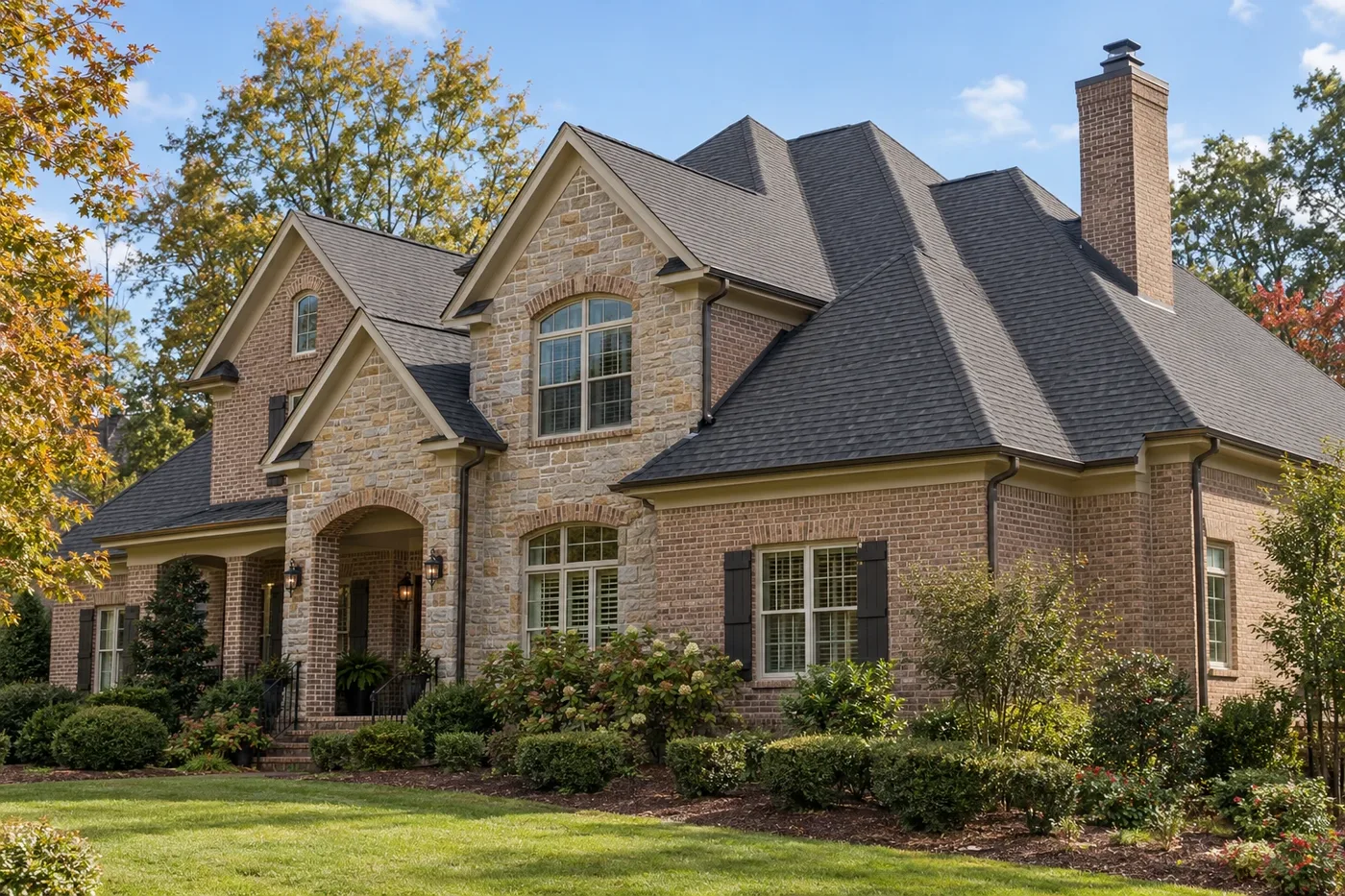
What apron flashing does at the lower side of a roof projection
Water running down a roof needs a clean path around every object that interrupts the shingle field. Along the sides of a chimney or dormer, step flashing typically works one shingle course at a time. At the lower, downslope face, apron flashing bridges the vertical surface to the roof and sends water back over the finished shingles below.
That location is easy to misunderstand because some metal is supposed to remain visible. Visible does not mean surface-mounted. The upper portion still has to connect correctly with the chimney, wall finish, curb, or counterflashing, while the lower portion must extend over the roof covering in a way that sheds water. The International Residential Code requires flashing at roof-and-wall intersections and says sidewall flashing must direct water away from the wall and onto the roof or into the gutter. The exact code and approved detail for one home depend on the adopted requirements and materials involved.
Apron flashing is also not interchangeable with drip edge, step flashing, a chimney cricket, or a bead of roof cement. Naming the component correctly helps keep the repair focused on the actual transition instead of treating every piece of roof metal as the same detail.
Why apron flashing starts leaking
The metal may be bent, split, corroded, punctured, too short, or pulled away from the surface it protects. Fasteners can loosen, mortar joints can deteriorate, sealant can age, and past work can leave the metal layered behind a shingle edge instead of over it. Wind-driven rain may reveal a weak lap that stays quiet during lighter showers.
The visible apron is not always the only problem. Water can enter higher at step flashing, counterflashing, siding, masonry, a cricket, or a roof penetration and travel to the lower edge before it appears. A stain below the apron therefore identifies an inspection area, not automatically the first opening.
Previous patches deserve close attention. Thick roof cement can hide a split, short overlap, open fastener hole, or corroded metal. Compatible roofing cement has legitimate uses in manufacturer-approved details and hand-sealing, but adding another layer over failed flashing does not rebuild the connection between the roof and the vertical surface.
When a focused apron-flashing repair is realistic
A localized repair is most practical when the apron is the confirmed failure, the surrounding shingles can be lifted without breaking, the deck remains sound, and the connected masonry, siding, trim, or curb provides a workable tie-in. Asphalt-shingle roofs are often repairable because individual courses can be carefully separated and restored over a limited area.
The repair boundary may still be larger than the strip of visible metal. Shingles immediately below and beside the apron may need to come out so the deck and underlayment can be inspected. Counterflashing or a small section of siding or trim may need access so the upper leg is not simply caulked to an exposed surface. Disturbed shingles then need correct fastening and product-specific hand sealing where original seal bonds were opened.
GAF guidance emphasizes proper step and counterflashing at roof-to-sidewall transitions and recommends new, appropriately sized corrosion-resistant step flashing when possible. Its homeowner guidance also notes that flashing can be added or improved after the original roof installation. Those points support repairability, but they do not make every existing apron reusable.
When replacement of the metal is more dependable than resetting it
Resetting sound metal may be reasonable when it is correctly shaped, long enough, free of serious corrosion, and capable of being reintegrated without leaving old holes or weak bends in critical locations. Replacement is usually clearer when the apron is split, sharply creased, rusted through, perforated, too small, poorly formed, or buried under several incompatible patches.
The scope also grows when the supporting deck is soft, the masonry joint is failing, siding or wall sheathing has moisture damage, or the side flashing above the apron was never installed correctly. Roofing work can restore shingles and flashing, but damaged masonry, wall cladding, framing, or structural material may require another qualified trade. The estimate should identify that boundary rather than promise that one piece of metal solves every condition around it.
One damaged apron still does not prove that the whole roof needs replacement. Broader work becomes a reasonable discussion when shingles around the repair are too brittle to open, several transitions are failing, moisture damage extends well beyond the detail, or there is no dependable place to tie the repair into sound roofing.
What a complete repair scope should document
Ask the estimate to name the roof projection and exact side being repaired. It should say whether the existing apron is reset or replaced, which shingles and fasteners are disturbed, how underlayment and decking are checked, how the upper flashing edge connects to the wall, chimney, curb, or counterflashing, and how concealed damage or added work will be approved.
Photographs should tell the same story. A wide image locates the repair. A close image shows the failed condition. Progress photos can document the exposed deck, underlayment, flashing laps, fastener placement, and the upper connection before those details disappear. The final image should show an orderly tie-in and an unobstructed path for water to move downslope.
Kaliber Roofing provides a one-year warranty for the roof-repair work it performs. That workmanship coverage is separate from a manufacturer material warranty and should be connected to the written repair boundary. Keep the approved scope, changes, invoice, photos, material information, and callback instructions together.
What Indian Trail homeowners can check safely
Stay on dry ground and use phone zoom. Photograph the full roof plane first, then the chimney, dormer, or projection from more than one angle. Look for a bent metal edge, a gap at the upper connection, rust streaks, cracked patch material, displaced shingles, or staining below the transition. Do not climb up to press on the metal or run a hose against it.
Inside, note when and where moisture appears. If attic access is safe, look only from a stable walking surface for a water track, dark deck area, damp insulation, or staining near the projection. Keep away from wet wiring and do not assume the first visible stain is directly below the exterior opening.
Kaliber serves Indian Trail first and offers same-day or next-day inspections subject to scheduling. A repair-first inspection should compare the exterior detail, surrounding roof, and interior evidence before deciding whether the apron can be reset, should be replaced, or is only where water finally became visible.
Related guidance
Common questions
Can roof cement permanently repair damaged apron flashing?
Roof cement can be appropriate in specific manufacturer-approved joints or concealed bonds, but it does not restore split, corroded, undersized, loose, or incorrectly layered metal. A lasting repair should correct the flashing assembly and use compatible sealant only where the applicable detail calls for it.
Do shingles have to be removed to repair apron flashing?
Usually at least some nearby shingles must be carefully opened or removed so the lower flashing edge, underlayment, decking, and fasteners can be inspected and rebuilt. The number of courses depends on the existing layout, material condition, and repair boundary.
Does damaged chimney apron flashing mean the whole chimney must be rebuilt?
No. Sound masonry may remain when the failure is limited to the apron or its connection. Loose brick, deep mortar deterioration, chimney movement, crown damage, or water entering higher on the chimney requires the appropriate masonry, chimney, or structural evaluation.
Does one failed apron flashing mean I need a new roof?
Not by itself. A focused repair may be dependable when the surrounding shingles, underlayment, decking, and connected wall or chimney details remain serviceable. Replacement becomes a broader question when those materials cannot support a reliable repair.
Sources and editorial notes
- 2024 International Residential Code, Chapter 9 roof flashing provisions
- GAF technical bulletin on proper roof flashing
- GAF homeowner guide to roof flashing and roof-to-wall transitions
- Asphalt Roofing Manufacturers Association guidance on localized shingle-roof repairs
Prepared with AI assistance and editorially reviewed by Sage. General homeowner guidance; not an on-site diagnosis, product-specific installation approval, code determination, warranty interpretation, or substitute for evaluation by the appropriate qualified professional.