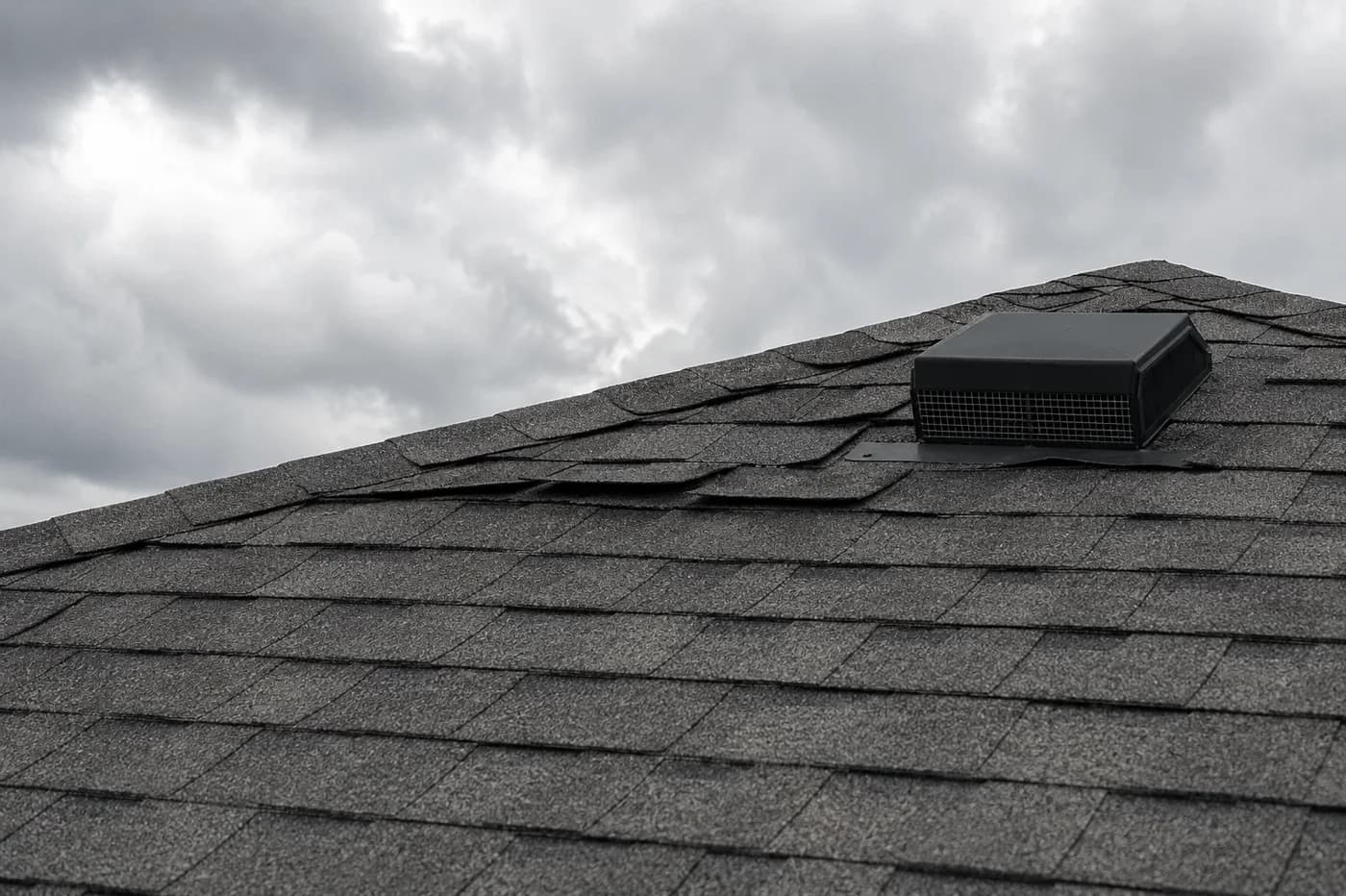
Shingles lift after wind when gusts break or loosen the adhesive seal strip that holds each tab down. In Indian Trail, a lifted shingle may settle back down if it is only slightly raised and the seal is still healthy, but creased, torn, brittle, or unsealed tabs need a roof inspection because wind-driven rain can get underneath them during the next Union County storm.
It is a common call after a loud night of wind: a homeowner walks outside, sees a few shingle tabs sitting up near the eave or ridge, and wonders if the roof is about to leak. Sometimes the damage is obvious. Other times it is subtle enough that it only shows from one angle in the morning light.
Kaliber Roofing is based in Indian Trail and handles storm damage roof inspections, roof repairs, and insurance restoration documentation across Union County, Stallings, Matthews, Monroe, Waxhaw, Weddington, Mint Hill, and the surrounding Charlotte metro. Our advice is simple: do not panic, but do not assume lifted shingles are harmless either.
Why Shingles Lift During Indian Trail Wind Storms
Asphalt shingles are designed to overlap in courses. Each tab usually has a factory seal strip that bonds to the shingle below once heat activates it. When strong gusts hit the roof edge, corner, ridge, or an exposed slope, air can get under a tab and flex it upward. Do that enough times, and the seal can weaken or break.
Indian Trail roofs see a mix of fast spring storms, summer thunderstorms, tropical-system leftovers, and windy cold fronts. A home in an open subdivision near Monroe Road can experience different wind exposure than a tree-sheltered home closer to Stallings or Matthews. Roof shape matters too. Gables, roof edges, dormers, valleys, and higher slopes can catch wind in different ways.
Age is part of the story. A newer roof with a healthy seal strip may resist lifting better. Older shingles can become brittle, lose granules, or have seal strips that no longer bond well. Installation details matter as well: nail placement, overdriven nails, low nails, starter strip quality, and edge flashing can all affect how the roof behaves when gusts hit.
Will Lifted Shingles Seal Back Down?
Maybe. If the tab lifted a little, did not crease, and the seal strip is still tacky enough, warm sun may help it sit back down. That is the best-case scenario. But from the ground, it is hard to tell whether the shingle simply lifted or whether the mat cracked while it was bending.
A crease is the big red flag. Once a shingle tab folds back far enough to crease, the asphalt mat may be weakened. Even if the tab lays flat later, it can be more vulnerable to leaks, granule loss, and future wind. Torn corners, missing tabs, exposed nail heads, and shingles that flap repeatedly are not wait-and-see issues.
One more thing: sealant is not a cure-all. Hand-sealing can be useful in the right repair, but smearing random roof cement under a shingle without checking for creases, nail issues, or water entry can hide the real problem. It can also make future documentation messier.
Warning Signs That Lifted Shingles Need Repair
Look for missing shingles, tabs that are folded back, diagonal creases, torn corners, exposed black underlayment, exposed nail heads, or granules collecting at downspout exits. If the same roof slope has several lifted areas, the wind may have affected more than the one tab you noticed.
Interior signs matter too. A new ceiling stain, damp attic insulation, musty smell, or water mark around a bath fan, light fixture, chimney, or wall line after the same storm should move the inspection up the list. Roof leaks do not always appear directly under the lifted shingle. Water can travel along decking, rafters, insulation, or ceiling drywall before it finally shows up.
Pay special attention to lifted shingles near roof edges, valleys, ridge caps, pipe boots, skylights, and chimney or wall flashing. Those areas already handle more water movement. Add a loose shingle tab and wind-driven rain, and a small problem can turn into a headache quickly.
What You Can Check Safely From the Ground
Start with the date and time of the wind event. Save weather alerts, take photos from the yard, and photograph any shingles you find on the ground. If you can safely see the roof from an upstairs window, take a photo from there. Do not climb onto a wet or wind-damaged roof. It is not worth the fall risk.
Walk around the home and look for related clues: bent gutter sections, loose fascia, displaced ridge cap pieces, granules near downspouts, or debris that hit the roof. Inside, check ceilings and attic areas only where access is safe. A quick photo record helps a roofer understand what changed and when.
If you are not sure whether the tabs are lifted, zoom in on your phone photos and compare roof slopes. One lifted tab can stand out because the shadow line looks different. Still, avoid making a final call from a picture. A shingle can look lifted because of lighting, normal edge curl, or perspective.
Seeing lifted shingles after an Indian Trail wind storm?
Request a Free InspectionHow Kaliber Inspects Lifted Shingles
Kaliber looks at the roof as a system. We check the lifted tabs, seal strips, nail placement, creasing, surrounding shingles, roof edges, flashing, ridge caps, gutters, and any interior leak signs. Photos are part of the process because you should be able to see what we are seeing.
If the issue is isolated, a targeted repair may be enough. If lifted shingles are widespread, brittle, repeatedly losing seal, or paired with other storm damage, we will talk through whether repair, monitoring, insurance documentation, or roof replacement planning makes more sense. No scare tactics. Just a clear explanation.
The key is timing. A lifted shingle that looks manageable today can become a missing shingle during the next storm. If you noticed raised tabs after wind in Indian Trail or nearby Union County, get them checked while the weather timeline is still fresh.
Frequently Asked Questions
Can lifted shingles seal back down after wind?
Sometimes a slightly lifted asphalt shingle can relax back down in warm weather if the seal strip is still intact. But if the tab is creased, torn, cracked, missing granules, or no longer bonded, it should be inspected instead of ignored.
Are lifted shingles considered storm damage?
They can be, especially when the lifting appears after a documented wind event and the shingles show creasing, torn seal strips, missing tabs, or matching damage on the same roof slope. Age, installation issues, and old seal failure can also play a role.
Will a few lifted shingles cause a roof leak?
A few lifted shingles may not leak right away, but they can expose nail lines, let wind-driven rain under the shingle course, and make the next storm worse. The risk goes up when lifting is near valleys, roof edges, penetrations, or already worn shingles.
Should I climb up and glue lifted shingles myself?
No. Stay off the roof, especially after rain or wind. DIY sealant can trap water, miss hidden creases, or complicate documentation. Take safe ground-level photos and have a roofer check the shingle condition and seal strip.
Does Kaliber Roofing inspect lifted shingles in Indian Trail NC?
Yes. Kaliber Roofing inspects lifted shingles, wind damage, missing tabs, roof-edge damage, and storm-related leaks across Indian Trail, Union County, Stallings, Matthews, Monroe, Waxhaw, Weddington, Mint Hill, and nearby Charlotte-metro communities.
Need a straight answer on lifted shingles in Indian Trail?
Kaliber Roofing will document the roof, explain whether the shingles are simply lifted or actually damaged, and recommend the smallest responsible next step.