Yes, a roof leak can cause attic mold in Indian Trail homes when water reaches the roof decking, insulation, or framing and stays damp long enough for mold to grow. The fix is not just wiping the attic stain. You need to stop the roof leak first, dry the wet materials, document the damage, and then decide whether cleanup, repair, or replacement makes sense.
This is one of those problems that can look small from inside the house. Maybe you notice a musty smell upstairs. Maybe a ceiling stain shows up after a hard Union County rain. Or maybe someone checks the attic and finds dark spotting on the underside of the roof deck.
Do not panic. But do not ignore it either. Attic moisture usually has a source, and around Indian Trail, Stallings, Matthews, Monroe, Waxhaw, and Weddington, that source is often a roof detail that only leaks during wind-driven rain or repeated storms.
Kaliber Roofing helps homeowners track roof leak sources, document storm damage clues, and choose practical next steps through roof repair inspections, storm damage assessments, and roof inspection appointments across Indian Trail and the surrounding Charlotte metro.
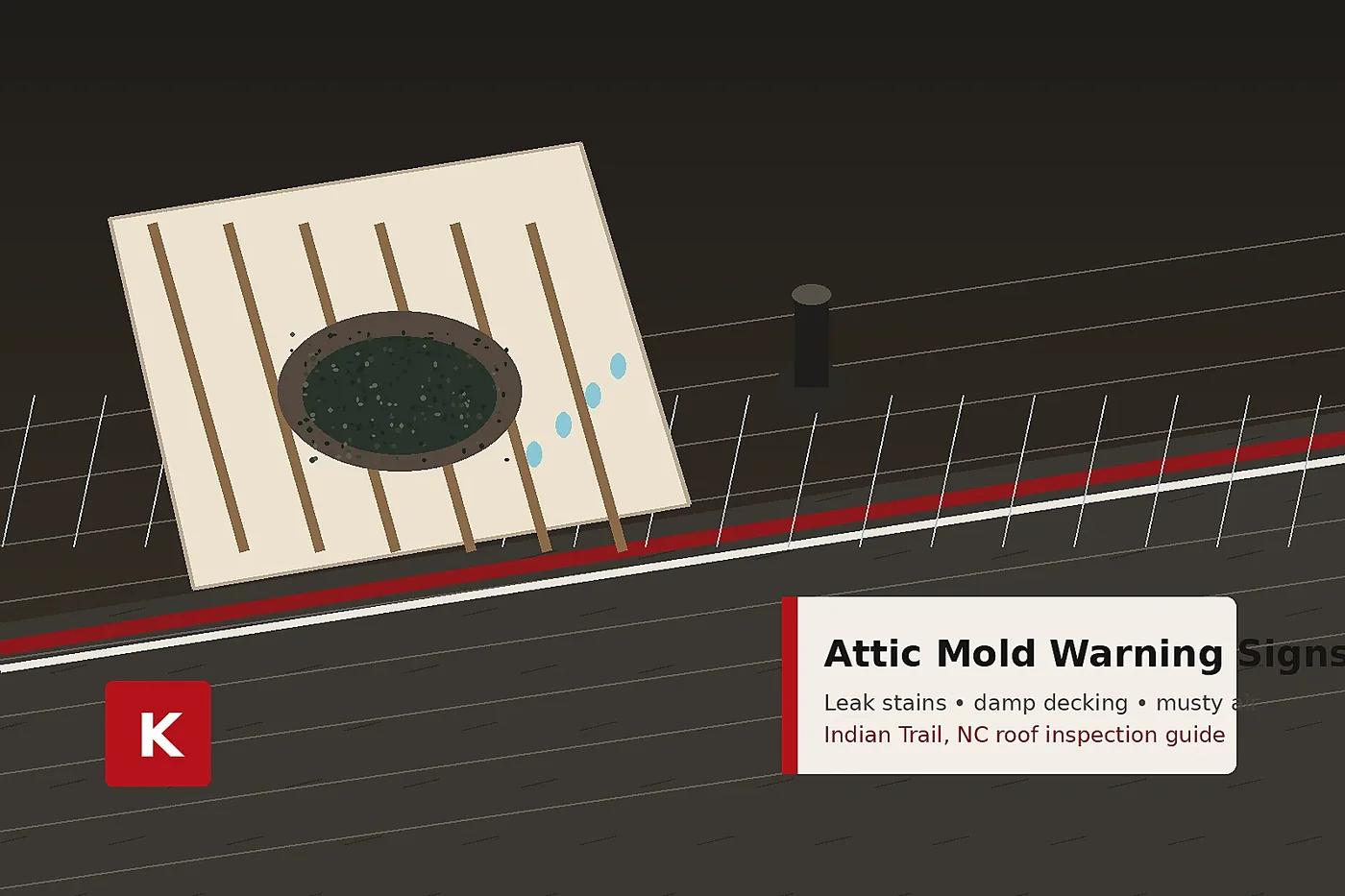
Why Mold Starts After a Roof Leak
Mold needs moisture, a surface to grow on, and the right temperature range. An attic can provide all three. Wood decking, rafters, paper-faced insulation, dust, and warm air can become a good hiding place once water gets past the roof system.
The tricky part is that attic leaks are not always dramatic. A pipe boot may drip only during heavy rain. Step flashing may leak when wind pushes rain sideways. A small valley issue can wet decking several times before a ceiling stain appears below.
By the time you smell it, the roof may have leaked more than once. That is why the inspection needs to be boring and methodical: find the entry point, check how far the water traveled, and look for ventilation issues that kept the attic damp longer than it should have been.
Warning Signs in the Attic
If you can safely look from the attic access, start with simple clues. Do not step between joists or walk around in a tight attic unless you know what you are doing.
Look for dark or fuzzy patches on the underside of roof decking, water trails on rafters, rusty roofing nails, wet or compressed insulation, daylight around a penetration, and staining below valleys, vents, chimneys, skylights, or roof-to-wall transitions.
A musty smell matters too. So does a bathroom fan that dumps humid air into the attic instead of outside. Not every attic mold concern is caused by a roof leak, but if the dark staining lines up with a roof penetration or storm pattern, the roof deserves a close look.
Common Roof Leak Sources Around Indian Trail Homes
Pipe boots are a common suspect. The rubber collar can crack from sun and age, then leak around a plumbing vent every time rain hits from the right angle.
Flashing details are another big one. Step flashing, kick-out flashing, chimney flashing, and dormer flashing all have to move water away from walls. If the detail is missing, loose, corroded, or covered by old caulk, water can sneak behind siding and into the attic or wall cavity.
Valleys and lifted shingles can also send water where it should not go. Indian Trail storms can bring quick downpours, wind gusts, and debris from nearby trees. A roof that handles light rain may still leak when water volume and wind direction change.
Ventilation problems can make the attic look worse. Poor intake, blocked soffits, disconnected bath fans, or weak ridge ventilation can trap humidity. Then a small roof leak has a damp attic waiting for it.
Seeing attic staining after rain?
Schedule a Roof Leak InspectionWhat To Do Next
First, stop adding moisture. If water is actively coming in, protect the interior with buckets, move belongings, and call for help. Do not climb onto a wet roof. It is not worth the fall risk.
Second, take photos. Get the ceiling stain, attic staining, wet insulation, exterior roof area, and the date of the storm if you know it. A few clear photos can help a roofer understand the path of the leak before shingles are disturbed.
Third, get the leak source inspected before cleanup. A mold remediation company can treat affected materials, but they cannot make a bad pipe boot, flashing joint, or roof valley shed water correctly. The roof has to be handled first.
After that, the answer may be a focused repair, a larger roof repair, ventilation correction, insulation work, or full roof replacement if the roof is already failing in several places. The point is to avoid guessing.
Insurance and Documentation Notes
Insurance questions depend on the policy and the cause. A sudden wind or hail event that damaged shingles can be handled differently than a long-term leak from age, maintenance, or installation problems.
That is why documentation matters. A useful roof inspection should show photos of the roof surface, the suspected entry point, attic moisture clues, and any storm-related damage such as creased shingles, missing tabs, punctures, hail marks, or damaged flashing.
If it turns out to be ordinary wear, you still need the roof fixed. If storm damage is involved, clear documentation helps you have a more informed conversation with your carrier. Either way, the best move is the same: find the leak source and stop the water.
Frequently Asked Questions
Can one roof leak cause mold in the attic?
Yes. One roof leak can create enough attic moisture for mold to start if the decking, insulation, or framing stays damp. The risk goes up when the leak repeats during several rains or the attic already has poor ventilation.
How fast can mold grow after a roof leak?
Mold can begin developing within a few days when moisture, warmth, and organic material are present. In real homes, the bigger problem is often a slow roof leak that stays hidden through multiple storms before anyone checks the attic.
Should I clean attic mold before fixing the roof leak?
Fix the water source first. Cleaning or treating mold before stopping the roof leak can turn into a repeat problem because the attic gets wet again during the next storm.
Will homeowners insurance cover attic mold from a roof leak?
It depends on the policy and the cause of the leak. Sudden storm damage may be handled differently than long-term wear, poor maintenance, or ventilation problems. Photos, dates, and a roof inspection report help clarify the situation.
Does Kaliber Roofing inspect attic leak sources near Indian Trail?
Yes. Kaliber Roofing inspects roof leaks, attic moisture clues, storm damage, flashing, pipe boots, valleys, and ventilation concerns in Indian Trail, Union County, Stallings, Matthews, Monroe, Waxhaw, Weddington, Mint Hill, and nearby Charlotte-metro communities.
Need the leak source checked before cleanup?
Kaliber Roofing can inspect the roof, document attic moisture clues, and explain the repair path clearly.